
Who Was Vladimir Kagan?
Vladimir Kagan (1927–2016) was one of the most distinctively original furniture designers America produced in the 20th century. Born in Germany and raised in New York, Kagan worked in his father's custom furniture workshop before establishing his own showroom on 57th Street in 1948 — a location that put him squarely in the world of high-end interior design from the beginning. His clients over the decades included Marilyn Monroe, Gary Cooper, and Walt Disney.
Kagan's work is immediately recognizable: sinuous curves, organic forms, and a comfort-forward sensibility that distinguished him from the more austere Scandinavian influences dominant in American modernism. His sofas sweep and curve. His chairs seem to reach toward the sitter. His forms are simultaneously sculptural and deeply livable — which is why his pieces have retained and grown their value across generations of collectors.
The Signature Pieces
The Contour Sofa
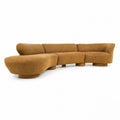
The contour sofa is Kagan's most iconic form — a deeply curved, free-floating silhouette with a walnut base that allows the sofa to be positioned off-wall in the center of a room. The serpentine back creates distinct seating zones within a single form. Available in two-seat and longer configurations. The contour sofa has been reproduced extensively, making authentication critical.
The Omnibus Sectional
Designed in the early 1970s, the Omnibus sectional system allowed individual components — sofas, chairs, ottomans — to be combined in configurations suited to any room. The Omnibus is distinguished by its low-slung profile, walnut base, and the quality of its cushion construction. Original Omnibus sections are among the most actively collected Kagan pieces today.
The Tri-Symmetric Chair
A three-point lounge chair with a dramatically cantilevered back and sculpted walnut frame — one of Kagan's most architecturally assertive pieces. Rarely found in pairs; single examples are already significant finds.
The Barrel Chair and Lounge Chair
Kagan produced numerous lounge chair variations across his career. The curved barrel chair — a tight cylinder of upholstery on a walnut base — and the open-frame lounge chairs with curved backs are among the most commonly traded pieces. Excellent entry points for new collectors.
Sculpted-Leg Tables
Kagan's coffee and side tables feature the same sculptural walnut legs as his seating, with glass, marble, or wood tops. A Kagan table paired with a Kagan sofa creates a coherent room with exceptional visual weight.
Authentication: Spotting Genuine Kagan
Kagan's popularity has generated a significant reproduction market. Key authentication markers for pre-2000 vintage originals:
- Labels and stamps: Look for "Vladimir Kagan Designs" labels or stamps on frame undersides or inside upholstery seams. Later pieces (1980s–90s) may carry "Kagan-Dreyfuss" branding.
- Frame construction: Authentic Kagan frames are solid walnut — heavy, precisely joined, with the characteristic sculptural shaping that reproductions approximate but rarely match in quality. Run your hand under the frame; the profiles should feel deliberate and smooth, not machine-routed.
- Cushion quality: Original Kagan cushions used high-density foam wrapped in down or dacron. The seat depth and cushion crown are specific to each model — reproductions typically use shallower cushions with less crown.
- Base design: The walnut bases on contour sofas and omnibus sections have specific leg angles and tapering profiles. Side-by-side comparison with documented originals is the most reliable check.
- Harvey Probber Furniture: The Complete Collector's Guide
- How to Style a Mid-Century Modern Living Room
Kagan-Dreyfuss vs. Early Vladimir Kagan Designs
In 1979, Kagan entered a partnership with Hugo Dreyfuss, creating Kagan-Dreyfuss Inc. Pieces from this period carry the Kagan-Dreyfuss label and represent a continuation — not a diminution — of the design vocabulary. The partnership produced pieces through the 1990s. For collectors, Kagan-Dreyfuss pieces are equally authentic Kagan designs; they simply reflect a different production era. Early Vladimir Kagan Designs pieces from the 1950s–1970s are rarer and command higher prices.
Kagan prices have risen significantly over the past decade as the designer's reputation has grown among younger collectors who discovered his work through design publications and social media. Early-production pieces (pre-1970) in clean condition are approaching the upper bounds of their historical range.
Restoration Considerations
Like Adrian Pearsall, Kagan frames are the irreplaceable element. The walnut frames on authentic Kagan pieces are exceptionally well-constructed and typically survive decades in structurally sound condition. Restoration focus areas:
- Frame inspection: Check all joints and leg connections. The cantilevered elements on Kagan pieces put specific stress on certain joint locations — these should be reinforced proactively.
- Walnut care: Original finishes respond well to quality furniture oil. Full refinishing should be avoided unless the finish is genuinely failed — original patina adds authenticity value.
- Reupholstery: The most common restoration investment. Period-appropriate fabrics — boucle, mohair, quality wool — enhance both aesthetics and resale value. Budget $2,000–$5,000 for a contour sofa reupholstery with quality textile.
Frequently Asked Questions
How do I identify Vladimir Kagan furniture?
Look for "Vladimir Kagan Designs" or "Kagan-Dreyfuss" labels on frame undersides or inside upholstery seams. Authentic pieces have solid walnut frames with sculptural, precise shaping, high-density cushions with down or dacron wrap, and specific base proportions that reproductions approximate but rarely match. The contour sofa, omnibus sectional, and tri-symmetric chair are the most recognized forms.
What is a Vladimir Kagan contour sofa worth?
An early vintage Vladimir Kagan contour sofa in original upholstery typically sells for $6,000–$15,000. Professionally reupholstered examples with clean frames can reach $8,000–$20,000. Frame authenticity and condition are the primary value drivers; reupholstery on a genuine Kagan frame is expected and accepted by collectors.
What is the difference between Vladimir Kagan Designs and Kagan-Dreyfuss?
Kagan-Dreyfuss Inc. was a partnership formed in 1979 between Vladimir Kagan and Hugo Dreyfuss that continued production of Kagan designs through the 1990s. Both labels represent authentic Kagan designs. Earlier Vladimir Kagan Designs pieces (1950s–1970s) are rarer and generally command higher prices, but Kagan-Dreyfuss pieces are equally legitimate vintage Kagan.
Is Vladimir Kagan furniture worth buying?
Yes — Vladimir Kagan furniture has appreciated significantly over the past decade and the trajectory remains strong. The combination of distinctive design, high build quality, and growing collector recognition makes authentic Kagan pieces reliable long-term value holds. Frame condition is the key purchase criterion; reupholstery investment is recoverable on a genuine piece.
Further Reading
- How to Value Vintage Mid-Century Modern Furniture
- How to Authenticate Vintage Mid-Century Modern Furniture
- Mid-Century Modern Furniture Restoration Guide
- Adrian Pearsall Furniture: The Complete Collector's Guide
- Mid-Century Modern Living Room Furniture Guide
Currently in Our Shop
Browse authentic Vladimir Kagan pieces currently available in our collection: