

Who Was Harvey Probber?
Harvey Probber (1922–2003) was one of the most inventive American furniture designers of the postwar era — and one of the least celebrated relative to his actual influence. Working from his own Harvey Probber Inc. in Fall River, Massachusetts, Probber spent four decades creating furniture that combined rigorous modernist geometry with a practicality and comfort that made his pieces genuinely livable. He was, in his own quiet way, one of the architects of the American interior.
Probber is perhaps best known today for his early adoption and refinement of modular seating — sectional sofas with standardized components that could be configured freely by the buyer. He held patents on modular seating concepts that predate and parallel similar systems later brought to market by better-known names. His brass-leg case goods and his jacks sofas are equally celebrated by the collectors who know his work.
Harvey Probber Inc.: The Workshop
Probber founded Harvey Probber Inc. in the mid-1940s and ran it as a design-forward operation that competed at the high end of the American furniture market. The company produced furniture through the 1980s, with the peak design output generally placed in the 1950s and 1960s. Pieces typically carry a Harvey Probber Inc. label — a foil or paper tag applied to frame undersides, drawer interiors, or back panels — sometimes accompanied by a design number.
The Fall River, Massachusetts origin is itself an authentication marker: genuine Probber pieces were American-made, and the construction quality reflects New England craft traditions applied to modernist design.
Signature Pieces
The Jacks Sofa
The jacks sofa — named for its resemblance to the classic children's game pieces — is Probber's most architecturally dramatic creation. The sofa's distinctive raised corner elements give it a sculptural quality that reads as a single bold object rather than a conventional seating piece. The jacks sofa appears rarely on the market; confirmed examples with intact structure and frames are significant finds.
Modular Seating Systems
Probber's modular seating was revolutionary for its era: standardized component units — sofas, corner pieces, ottomans — that could be combined in any configuration. The components are typically low-slung with clean-lined brass or walnut bases, generous cushioning, and the careful proportioning that characterizes all of Probber's work. Sets are worth substantially more than individual components.
Brass-Leg Case Goods
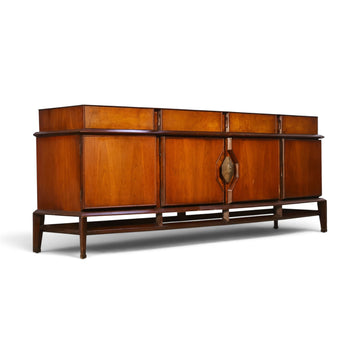
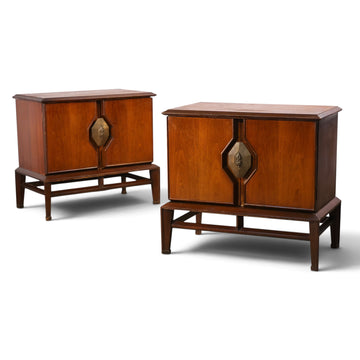
Probber's credenzas, cabinets, and sideboards with characteristic brass legs are among the most collected examples of his work. The brass base — slender, precisely machined, with a quality of casting that distinguishes authentic Probber from inferior copies — elevates otherwise clean-lined case forms into genuine sculptural statements. Original brass in unpolished or lightly patinated condition is preferable to polished or replaced hardware.
Lounge Chairs
Probber designed numerous lounge chair forms — curved backs, walnut or brass frames, generous proportions. Single chairs appear more frequently than complete sets; pairs are significantly more valuable. The upholstery is replaceable; the frame integrity and base hardware are not.
Authentication: Identifying Genuine Probber
The Harvey Probber market has a modest reproduction problem — the brass-leg aesthetic in particular has been widely imitated. Key authentication points:
- Harvey Probber Inc. label: Foil or paper tag on frame undersides, drawer interiors, or back panels. Not all pieces retain labels, but presence confirms authenticity.
- Brass quality: Probber's brass hardware is solid, precisely cast, and substantial. The legs on case goods have a specific taper profile and a weight that distinguishes them from lighter imitations. Knock on them — hollow sounds indicate inferior casting.
- Construction quality: Dovetailed drawer joints, solid hardwood carcasses, fitted hinges on cabinet doors. The internal construction quality of Probber case goods is a consistent authentication marker.
- Proportions: Probber's pieces have carefully considered proportions — not just aesthetically but ergonomically. Seating that feels too shallow, too narrow, or awkward in use is often not genuine Probber.
- How to Style a Mid-Century Modern Living Room
Condition Considerations
The most important elements to assess on any Probber piece:
- Brass hardware: Original brass in any condition (including well-patinated) is preferable to replaced hardware. Polished brass that shows filing or buffing marks may indicate restoration work. Missing brass elements are difficult to source and significantly affect value.
- Case good surfaces: Probber typically used walnut veneers over solid wood substrates on case goods. Veneer condition — especially on tops — is a primary value indicator. Lifted edges, bubbling, or patched veneer are significant deductions.
- Structural integrity on seating: Modular sofa components should be checked at all connection points. Individual units that are loose or show frame damage affect both function and value.
Collecting Strategy
Probber remains somewhat undervalued relative to contemporaries of equivalent design achievement — which makes this a good time to collect. The best approach: prioritize pieces with confirmed labels, intact original brass, and sound structural condition. Seating can be reupholstered; case surfaces can be professionally restored; but brass that's missing or replaced is nearly impossible to correct.
The modular seating system is the most interesting area for dedicated collectors — assembling complete, matching sets of Probber modular components in consistent upholstery creates a room anchor of genuine rarity and design significance.
Frequently Asked Questions
How do I identify Harvey Probber furniture?
Look for Harvey Probber Inc. labels — foil or paper tags — on frame undersides, drawer interiors, or back panels. Authentic pieces feature solid, precisely cast brass hardware with characteristic taper profiles, dovetailed drawer joints, solid hardwood carcasses, and the careful ergonomic proportioning that distinguishes Probber's work. The Fall River, Massachusetts origin and American-made construction are also consistent markers.
What is the Harvey Probber jacks sofa?
The Harvey Probber jacks sofa is named for its resemblance to the classic children's game pieces — its distinctive raised corner elements give it a sculptural quality unlike conventional seating. It is one of Probber's most architecturally dramatic designs and among his rarest pieces on the vintage market today.
When was Harvey Probber furniture made?
Harvey Probber Inc. was founded in the mid-1940s and produced furniture through the 1980s. The most collectible pieces come from the 1950s and 1960s, which represent the peak of Probber's design output. The company was based in Fall River, Massachusetts.
Is Harvey Probber furniture undervalued?
Many collectors and dealers consider Harvey Probber furniture undervalued relative to contemporaries of equivalent design achievement. His innovations in modular seating and his quality of craft rival better-known names; growing collector interest has been increasing recognition and values over the past decade.
Further Reading
- How to Value Vintage Mid-Century Modern Furniture
- How to Authenticate Vintage Mid-Century Modern Furniture
- Mid-Century Modern Furniture Restoration Guide
- Edward Wormley & Dunbar Furniture: The Complete Collector's Guide
- Paul McCobb Furniture: The Complete Collector's Guide
Currently in Our Shop
Browse authentic Harvey Probber pieces currently available in our collection:
Browse all Harvey Probber pieces →
Further Reading
- T.H. Robsjohn-Gibbings Furniture Collector's Guide — Like Probber, Robsjohn-Gibbings brought European sophistication to American modernism with an emphasis on quality craftsmanship over mass production.


