

The short answer
- Measure two things: the spot where the piece will live, and every door, hallway, stair and turn on the way there.
- A dresser or credenza usually goes through a doorway on its side, so compare the piece's depth to the door width, not its length.
- Leave at least 24 inches of open floor in front of a dresser so the drawers can open all the way.
- Vintage sales are often final, so check the listed size against your tape measure before you buy, and ask the seller if anything is close.
Falling for a long walnut lowboy is the easy part. Getting it up the stairs, around the corner and against the right wall is where things go wrong. Vintage pieces are one of a kind, and many vintage dealers, including us, sell them as final sale, so a few minutes with a tape measure before you buy saves a lot of heartache. Here is how we suggest measuring for a vintage dresser or credenza, step by step.
What you need
- A metal tape measure (a cloth sewing tape stretches)
- Painter's tape
- Your phone, for notes and photos
- A second person, if you can borrow one, for long runs and stairwells
Step 1: Read the listing the right way
Furniture is listed as height, width and depth. Width is side to side across the front. Depth is front to back. Height is floor to top. On a dresser or credenza the width is almost always the biggest number, and the depth is the smallest.
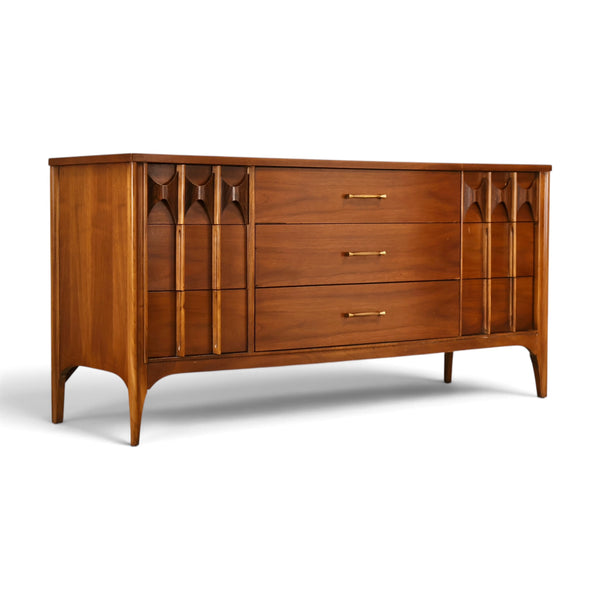
For example, the Kent Coffey Perspecta nine drawer lowboy we have right now measures 31 inches high, 64 inches wide and 19 inches deep. That 19 inches is the number that matters most at your front door. The 64 inches is the number that matters on your bedroom wall.
Keep in mind that vintage pieces are measured by hand, and listings can be rounded by half an inch or so. If your space is tight within an inch, ask the seller to measure again before you buy.
Step 2: Measure the spot where it will live
Wall width
Measure the open wall from corner to corner, or from corner to the edge of a door or window frame. Measure at floor level and again at the height of the top of the piece, because baseboards, trim and window sills can steal an inch or two.
Depth into the room
The dressers and credenzas we carry usually run about 17 to 21 inches deep. Still, check for heating vents, radiators and outlets that might sit behind the piece, and for baseboards that keep it from sitting flush.
Height
Check what sits above the spot: a window sill, a wall-mounted television, a light switch or artwork. A low credenza like the Broyhill Brasilia II petite credenza, at 24 inches high, can sit under many windows where a taller dresser would not.
Room to open drawers and doors
This is the measurement people forget. Design guides generally recommend at least 24 inches of clear floor in front of a dresser so drawers can open fully and you can stand in front of them, and some suggest more if the space is also a walkway. Check that drawers will clear the bed, and that cabinet doors on a credenza can swing open without hitting a chair or a wall.
Tape it out
Mark the footprint on the floor with painter's tape and live with it for a day. If you trip over the tape, you will trip over the dresser. For height, a strip of tape on the wall at the top line helps you picture how a tall piece sits next to windows and art.
Step 3: Measure the path in
A piece that fits the room still has to get there. Walk the route from the curb or driveway to the room and measure each tight spot. Furniture delivery guides from retailers like Design Within Reach give the same basic rule: the width of every door, hallway and stairway has to be larger than the depth or height of the piece, whichever way it will be carried.
Doorways
Measure the narrowest point of the opening, inside the trim, with the door open. The open door itself takes a little off the opening, so taking it off its hinges can buy you some extra room. A dresser is normally carried on its side or tipped back, so it needs a door wider than its depth. Since most vintage dressers are only about 17 to 21 inches deep, the front door is rarely the problem.
Hallways and corners
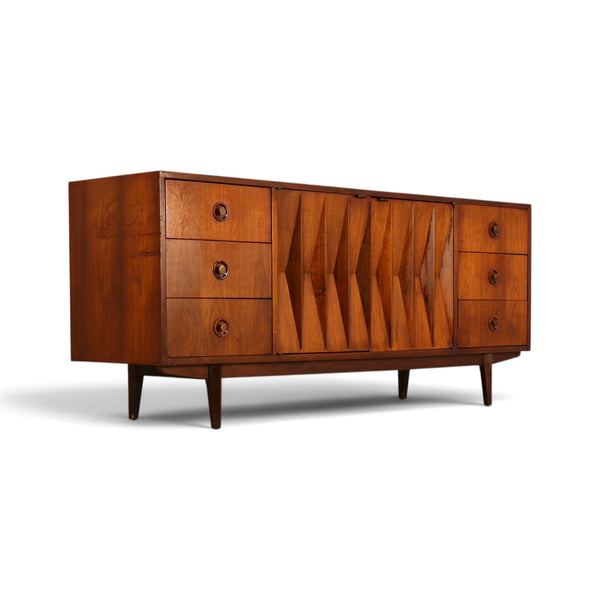
This is where long pieces get stuck. An 80 inch credenza that slides through a front door with ease can still jam at a 90 degree turn in a narrow hallway. Measure the hallway width, note every turn, and look for things that stick out like radiators, railings and light fixtures.
Stairs
Measure the stair width between the handrail and the wall, not wall to wall. Then measure the ceiling height at the bottom and top steps, and look for a low landing or a turn halfway up. Tall pieces like highboys need head room when they are tipped on a staircase.
Elevators
For apartments, measure the elevator door opening and the inside of the cab, including the diagonal from a bottom front corner to the top back corner. Ask your building whether you need to reserve the freight elevator or book a time for deliveries.
The diagonal trick
When a piece has to be tipped to get through a tight spot, its diagonal matters. Measure from the bottom back corner to the top front corner of the piece, or work it out from the listing. That Perspecta lowboy, at 31 inches high and 19 inches deep, has a diagonal of about 36 inches. If it needs to be stood up and swung around a corner, that is the clearance it needs.
Step 4: Look for pieces that come apart
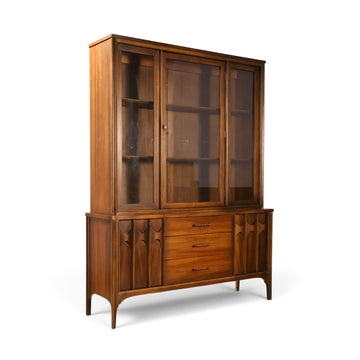
Many vintage case pieces are easier to move than they look. Two piece china cabinets and some tall chests are made as a top that lifts off a base, which makes stairs far easier. Our Red Lion two piece china cabinet, for example, is a hutch that sits on a separate buffet. Dresser mirrors that mount to the back of a case can usually be taken off for the move, too. Ask the seller which parts separate before delivery day.
Step 5: Share it before you buy
When you buy from Mod City Madness, every piece is sold as-is, as pictured, with the option to add restoration at purchase, and all sales are final. That is exactly why we want you to measure first. A few tips:
- Ask for more. We are happy to send extra photos or video, and to check any measurement that matters to your space.
- Tell us about the path. When you request a shipping quote, use the delivery notes to mention stairs, narrow doorways, elevators or a tight turn. Most domestic deliveries are white glove, with the carrier bringing the piece inside and setting it in place, but they need to know what they are walking into.
- Come see it. Local pickup is available from our warehouse in Denville, New Jersey, and buyers are always welcome to view a piece in person before buying.
For more on what happens once you have ordered, see our guide on how vintage furniture is shipped, and our tips on buying vintage furniture online with confidence.
Shop this look
Here are a few dressers and credenzas available now, with their listed sizes so you can check them against your space. Each is sold as-is, as pictured, with restoration available at purchase.
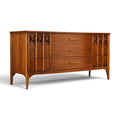
- Kent Coffey Perspecta Nine Drawer Lowboy Dresser: 31 inches high, 64 wide, 19 deep. Walnut with carved rosewood.
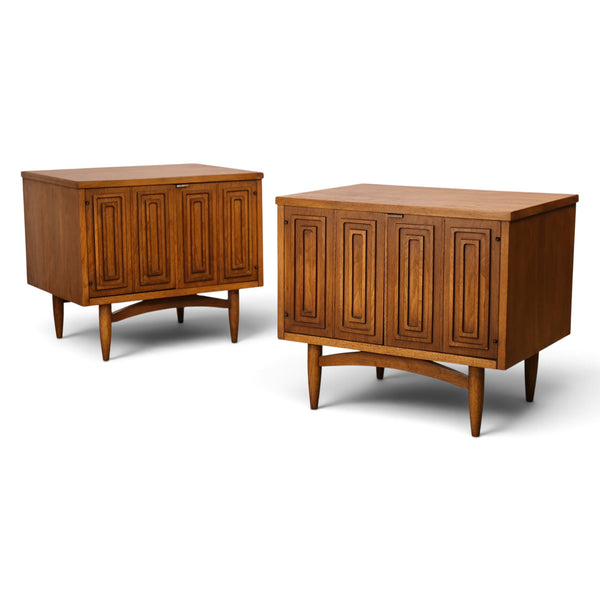
- Broyhill Brasilia II Petite Credenza: 24 inches high, 62 wide, 17 deep. A low profile that fits under windows and in apartments.
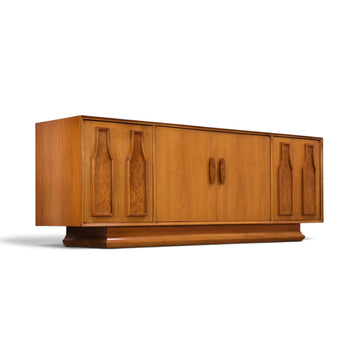
- Specialty Woodcraft Sculpted Walnut and Burl Credenza: 29 inches high, 81.5 wide, 19 deep. Measure your hallway turns for this long beauty.
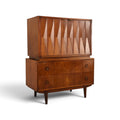
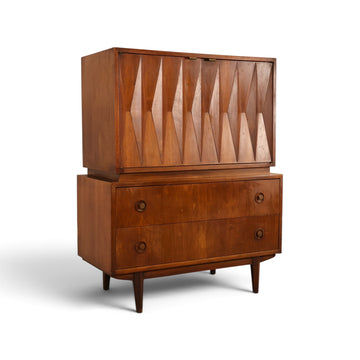
- Young Manufacturing Concave Highboy Dresser: 56.5 inches high, 42 wide, 20.75 deep. Lots of storage on a small footprint.
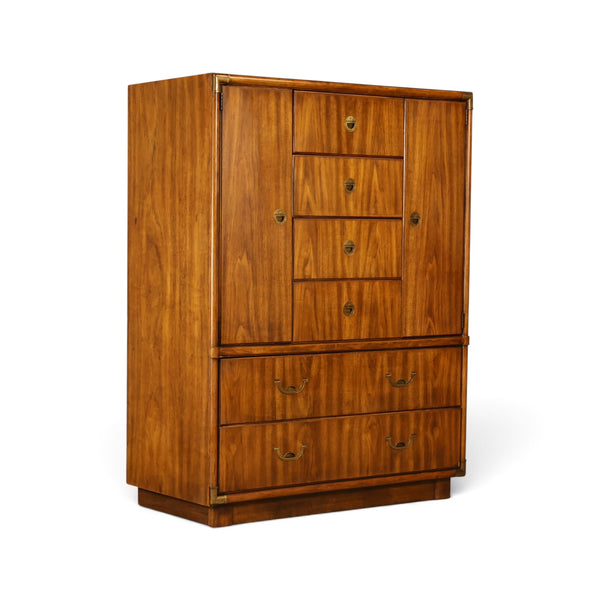
- Red Lion Two Piece China Cabinet: 75 inches high, 64 wide, 20 deep, in two pieces.
Browse the full dressers and nightstands collection or our credenzas, sideboards and bar cabinets.
Own one? We buy and consign mid century furniture
If you have a dresser or credenza that no longer fits your space, we would love to see it. Send us photos through our consignment form and we will take a look.
Looking for something specific? We'll find it. Send us your measurements and the style you love on our sourcing request page.
Common questions
Will a dresser fit through a standard doorway?
Usually, yes. A dresser is carried on its side or tipped back, so it needs a doorway wider than its depth. Most vintage dressers are only about 17 to 21 inches deep, but always measure the narrowest point of your door opening, inside the trim, to be sure.
How much space do I need in front of a dresser?
Design guides generally recommend at least 24 inches of clear floor in front of a dresser so the drawers can open fully, and more if the space doubles as a walkway.
What does height, width and depth mean on a furniture listing?
Height is floor to top, width is side to side across the front, and depth is front to back. On a dresser or credenza, width is usually the largest number and depth the smallest.
Can I return a vintage piece if it does not fit?
At Mod City Madness all sales are final, so measure your space and the path in before you buy. We are glad to send extra photos or video and double-check any measurement first.