

Mid-century modern is one of the most popular design aesthetics in the world today — and also one of the most misunderstood. The term gets applied to everything from authentic 1950s Danish teak furniture to mass-produced "MCM-inspired" pieces sold at big box stores that share only a passing visual similarity to the originals. This guide is a complete primer: what mid-century modern actually is, where it came from, what makes it distinctive, who made it, and how to recognize and buy the real thing.
What Does "Mid-Century Modern" Mean?
Mid-century modern (often abbreviated MCM) refers to a design movement that flourished roughly from the mid-1940s through the late 1960s — the middle of the 20th century. The "modern" part refers to the movement's break from historical ornamentation and its embrace of new materials, clean lines, and functional design principles that had been developing in architecture and industrial design since the 1920s.
In furniture terms, mid-century modern is characterized by:
- Clean, horizontal lines without heavy ornamentation or carving
- Tapered legs — often splayed at an angle — that give pieces a light, floating appearance
- Natural wood as the dominant material, particularly walnut, teak, rosewood, and maple
- Low-slung proportions that reflect the era's preference for open floor plans and casual living
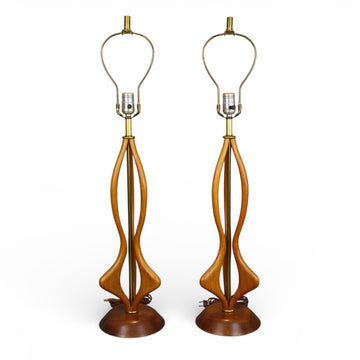
- A mix of organic shapes and geometric forms
- New materials used boldly: fiberglass, molded plastic, plywood, chrome, and aluminum
- Upholstery in bold colors and patterns, or in leather with a simple, tailored silhouette
The style emerged from a specific cultural and historical moment — postwar optimism, new manufacturing technologies, the rise of the American middle class, and a collective desire to build a new world rather than continue the old one.
A Brief History of Mid-Century Modern Design
Roots: The Bauhaus and Modernism (1920s–1930s)
MCM didn't emerge from nowhere. Its intellectual and aesthetic roots go back to the Bauhaus school in Germany, which taught that function and beauty were inseparable and that good design should be democratic — available to everyone, not just the wealthy. When the Nazis closed the Bauhaus in 1933, many of its faculty and students emigrated to the United States and Scandinavia, where they profoundly influenced the next generation of designers.
The Postwar Explosion (1945–1955)
World War II accelerated the development of new materials and manufacturing techniques. Plywood could be bent into complex curves. Fiberglass could be molded into organic forms. Aluminum and chrome could be die-cast at scale. Designers like Charles and Ray Eames seized on these technologies to create furniture that was simultaneously more expressive and more affordable than anything before.
At the same time, the American suburb was being built. Millions of families were moving into new ranch-style homes — low, horizontal, with open floor plans — that demanded furniture scaled and designed to match. Traditional heavy furniture looked wrong in these new houses. MCM furniture looked right.
The Golden Era (1955–1968)
The late 1950s and 1960s represent the high point of MCM design. Scandinavian designers — Hans Wegner, Arne Jacobsen, Finn Juhl, Børge Mogensen — were producing furniture that combined extraordinary craftsmanship with organic modernism. American designers like George Nelson, Harry Bertoia, and Eero Saarinen were creating iconic pieces that still define the era visually. Major American manufacturers — Lane, Drexel, Bassett, Broyhill, Heywood-Wakefield — were translating the MCM aesthetic into production furniture that middle-class families could actually afford.
This democratization is one of MCM's defining characteristics: the aesthetic ideas that originated in design studios found their way into American bedrooms, dining rooms, and living rooms at scale.
The Decline (Late 1960s–1970s)
By the late 1960s, MCM was beginning to give way to other aesthetics — Mediterranean revival, Spanish colonial, the heavy wood furniture of the early 1970s. Many MCM production lines ended, factories converted, and a generation of beautifully made furniture entered the secondary market, where much of it remained undervalued for decades.
The Revival (1990s–Present)
Interest in MCM revived in the 1990s and has accelerated through the 2000s and 2010s to the point where the style dominates interior design media. What was sold for $50 at estate sales in the 1980s now commands hundreds or thousands of dollars. The combination of genuine quality, historical design significance, and continued aesthetic relevance has made authentic MCM furniture one of the strongest-performing categories in the vintage market.
The Key Characteristics of MCM Furniture
The Line
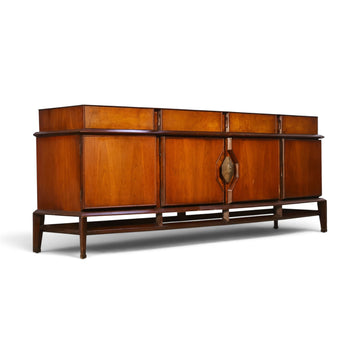
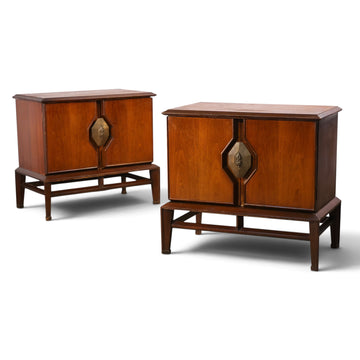
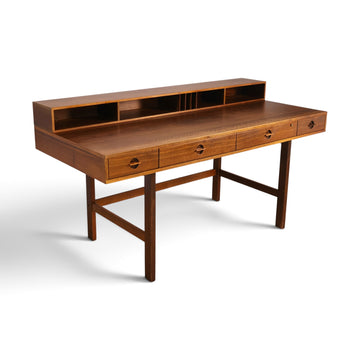
MCM furniture has an almost architectural quality to its lines. Case pieces — dressers, credenzas, sideboards — tend to be horizontal: long and low rather than tall and vertical. Legs are prominent rather than hidden, which creates the characteristic "floating" appearance. There is minimal molding, no applied carving, no ornate hardware. Every element serves a purpose.
The Materials
Walnut is the defining wood of American MCM. Its warm chocolate-to-amber tones, fine grain, and workability made it the material of choice for production furniture throughout the era. High-quality pieces use solid walnut or walnut veneer over solid wood cores.
Teak dominates Scandinavian MCM — particularly Danish furniture. Teak's natural oils make it durable and weather-resistant; its warm honey-brown tones and distinctive grain are immediately recognizable. Danish teak furniture is among the most collected MCM furniture in the world.
Rosewood appears on premium pieces — Brazilian rosewood in particular was widely used in high-end Scandinavian furniture until it became protected in the 1990s. Rosewood pieces now command significant premiums.
Fiberglass, molded plywood, and chrome appear on iconic designer pieces — Eames chairs, Saarinen tulip chairs, Bertoia diamond chairs. These require different care than wood furniture and occupy a distinct collector market.
The Hardware
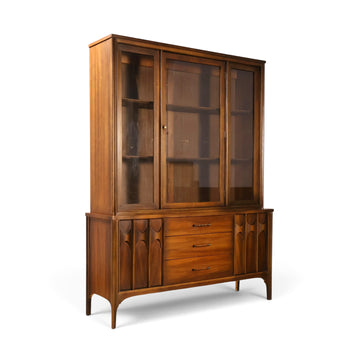
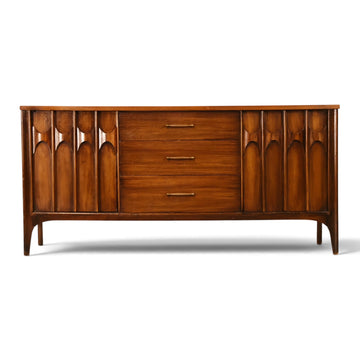
MCM hardware is minimal and purposeful. Drawer pulls are often small solid brass or chrome handles in simple geometric or tapered forms. Some pieces use recessed edge pulls with no visible hardware at all. The hardware is designed not to draw attention — it serves the furniture without competing with it. Notable exceptions exist: Broyhill Brasilia's starburst pulls are themselves an aesthetic statement.
The Legs
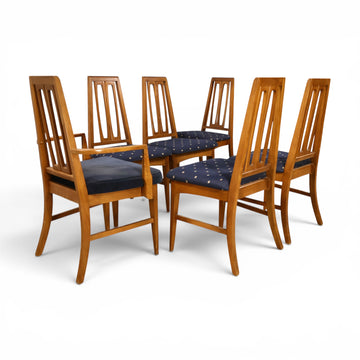
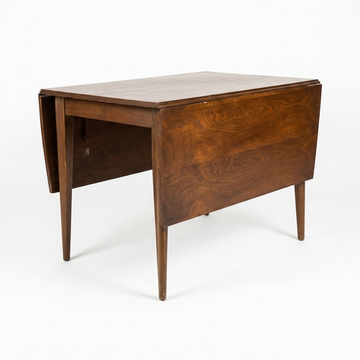
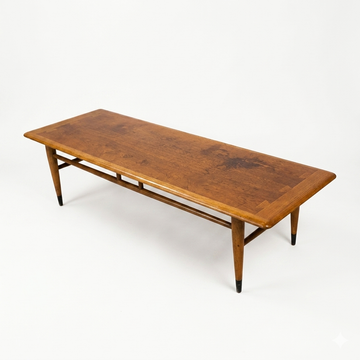
Perhaps the single most identifiable MCM characteristic is the leg. Straight tapered legs, angled splayed legs, hairpin legs, and pedestal bases all appear in MCM furniture — all sharing the purpose of making pieces appear lighter and more dynamic than furniture that sits flat on a plinth or skirt. The exposed leg is a declaration that this furniture belongs to a new era.
MCM by Country: Scandinavian vs. American
The two dominant traditions within MCM are Scandinavian (primarily Danish) and American, and they're genuinely distinct:
Scandinavian MCM tends toward more refined craftsmanship, lighter wood tones (teak and birch are more common than walnut), more organic curves, and higher prices for authentic pieces. Danish furniture in particular was made in smaller workshops with higher standards of joinery and finishing. See our full comparison in Scandinavian vs. American MCM furniture.
American MCM was largely production furniture — made at scale in factories in North Carolina, Virginia, and the Midwest. This doesn't mean low quality: the best American MCM production (Lane, Drexel, Heywood-Wakefield, Thomasville) is genuinely excellent furniture. It means a wider range of quality from exceptional to mediocre, and generally more accessible pricing than their Scandinavian counterparts.
Key Designers and Makers
American Designers
- Charles and Ray Eames — The central figures of American MCM design. The Eames lounge chair, the DCW dining chair, the molded fiberglass shell chairs. Authentic vintage Eames pieces command substantial premiums.
- George Nelson — Head of design at Herman Miller, Nelson created iconic pieces including the Marshmallow sofa, the Platform bench, and the ball clock that became symbols of the era.
- Eero Saarinen — The Tulip chair and table, the Womb chair. Saarinen pursued a vision of furniture without the "slum of legs" — pedestal bases that unite a piece with its base into a single sculptural form.
- Harry Bertoia — The Diamond chair and Bird chair, produced for Knoll. Wire mesh furniture as pure sculpture.
- Paul McCobb — Clean-lined American MCM furniture designed for accessibility. McCobb's Planner Group and Linear Group pieces are increasingly collectible.
Scandinavian Designers
- Hans Wegner — "The Chair," the Wishbone chair, the Shell chair. Wegner designed over 500 chairs in his lifetime, many of which are in continuous production today.
- Arne Jacobsen — The Egg chair, the Swan chair, the Ant chair. Jacobsen's designs have an organic modernity that remains completely fresh.
- Finn Juhl — Among the most sculptural of the Danish furniture designers. Juhl's pieces treat furniture as three-dimensional art; they're increasingly valuable.
- Børge Mogensen — More spare and functional than Juhl, Mogensen's furniture reflects Shaker influences combined with Danish craft. His Spanish chair is an iconic piece.
American Production Brands
The production brands are where most collectors spend most of their time — affordable relative to designer pieces and widely available:
- Heywood-Wakefield — Solid maple/birch furniture with a distinctive blond, optimistic aesthetic. Highly collectible.
- Lane Furniture — Acclaim, Staccato, and other beloved lines in walnut. Strong collector market.
- Drexel — Mid-to-upper tier American production. The Declaration collection is especially sought after.
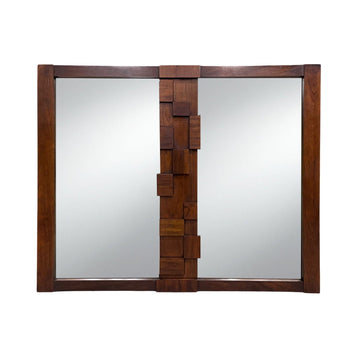
- Broyhill Brasilia — The most visually distinctive American MCM production line. The starburst carving is instantly recognizable.
- Thomasville — Consistently high quality, undervalued relative to construction. The Flair collection is exceptional.
- Bassett — Wide quality range; the Artisan and Mayan lines are the most collectible.
How to Identify Authentic MCM Furniture
With the popularity of MCM has come a wave of reproductions, "MCM-inspired" pieces, and misidentified furniture. Key authentication points:
- Construction: Authentic vintage MCM uses solid wood or quality veneer over wood cores. Modern reproductions often use MDF or particle board with thin vinyl wrap.
- Joinery: Dovetail drawers, mortise-and-tenon joints, solid wood secondary construction.
- Labels: Most American production furniture was marked by the manufacturer — Broyhill, Lane, Drexel, etc. Finding the original label is the fastest authentication.
- Patina: Authentic vintage pieces show 50–70 years of wear in consistent ways: slight darkening in handled areas, minor surface scratches consistent with use, hardware oxidation.
- Weight: Solid wood furniture is heavy. Suspiciously light "vintage" furniture is worth scrutinizing.
Read our complete guide on how to identify and authenticate vintage MCM furniture for a detailed checklist.
MCM by Room
We've written dedicated guides for furnishing each major room in the MCM style. Use these as deeper references once you understand the foundational aesthetic:
- How to Design a Mid-Century Modern Living Room
- How to Design a Mid-Century Modern Dining Room
- Mid-Century Modern Bedroom Furniture: The Complete Buyer's Guide
- How to Design a Mid-Century Modern Home Office
Buying Authentic MCM Furniture
The authentic vintage MCM market is active and, in some categories, competitive. A few principles for successful buying:
Know what you're buying before you bid. The most expensive mistakes come from buying based on looks alone without understanding construction, brand, and condition implications. Our guides on buying vintage furniture online and authenticating vintage MCM will help you buy with confidence.
Condition drives value more than brand. A mint condition Lane dresser is worth more than a damaged Drexel. Understand what restoration costs before letting condition discount sway your decision.
Shipping is manageable. Don't limit yourself to local buying. Read our guide to shipping vintage furniture — buying from dealers nationwide opens up a much larger selection.
Browse our current inventory of authenticated vintage MCM pieces — we add new pieces regularly and ship nationwide: view all available pieces.
Caring for MCM Furniture
Vintage MCM furniture that's survived 50–70 years deserves proper care to last another 50. The basics: regular dusting, appropriate oil or wax for your finish type, protection from direct sunlight and humidity extremes. Our complete vintage wood furniture care guide covers everything you need to know.
Frequently Asked Questions
What years are considered mid-century modern?
The mid-century modern period is generally defined as approximately 1945 to 1969 — the middle decades of the 20th century. Some definitions extend slightly earlier (to around 1933, when Bauhaus-influenced designers began emigrating) or later (to the early 1970s, when MCM production was winding down). The classic golden era is 1955–1965.
Is mid-century modern the same as retro?
Not exactly. "Retro" is a broader, less specific term referring to styles that evoke a past era. MCM is a specific design movement with defined aesthetic characteristics, a historical origin, and a set of associated designers and manufacturers. All MCM is retro in the general sense, but not all retro is MCM.
What's the difference between mid-century modern and contemporary modern?
Mid-century modern is a historical style from the 1940s–1960s. Contemporary modern refers to current minimalist design, which is influenced by but not the same as MCM. MCM tends to be warmer (natural wood, organic forms), while contemporary modern is often cooler (concrete, glass, pale woods). Mixing the two works well in interiors.
Why is mid-century modern so popular right now?
Several converging factors: the television show Mad Men (which premiered in 2007) introduced the aesthetic to a new generation; the WFH movement created demand for thoughtfully designed home interiors; rising interest in sustainability and quality over fast furniture; and a general appreciation for the optimism and craftsmanship of the era. MCM also photographs exceptionally well, which helps in an Instagram-driven design culture.
What's the most valuable mid-century modern furniture?
At the high end: original Herman Miller Eames lounge chairs, authenticated Finn Juhl pieces, Hans Wegner "The Chair," and other named designer pieces from major Scandinavian workshops can command tens of thousands of dollars. For production American MCM, complete matched bedroom suites from Heywood-Wakefield or Broyhill Brasilia in exceptional original condition represent the top of the market.
Further Reading
- How to Identify and Authenticate Vintage MCM Furniture
- Scandinavian vs. American Mid-Century Modern Furniture
- Most Collectible Mid-Century Modern Furniture Brands
- MCM Furniture Restoration: A Complete Guide
- How to Care for Vintage Wood Furniture
- How to Buy Vintage Furniture Online: A Complete Guide
- Florence Knoll Furniture Collector's Guide — the modernist behind some of the most iconic MCM office and lounge pieces.
- Arne Jacobsen Furniture Collector's Guide — the Egg, Swan, and Series 7 chairs that defined Scandinavian MCM design.
- Charles & Ray Eames Furniture Collector's Guide
- Eero Saarinen Furniture Collector's Guide


