
Florence Knoll: The Woman Who Defined the Modern American Office
Florence Knoll (1917–2019) is arguably the most consequential figure in twentieth-century American interior design. As a designer, architect, planner, and the creative force behind Knoll Associates, she shaped not only a furniture company but the entire visual language of the mid-century modern workplace. Her personal designs — spare, rigorously geometric, and precisely detailed — remain among the most recognized and collected works in modern furniture history.
This guide covers Florence Knoll's biography, her most important furniture designs, how to identify and authenticate vintage Knoll pieces bearing her work, and what collectors need to know when buying in the current market.
Florence Knoll: A Brief Biography
Born Florence Schust in Saginaw, Michigan, she was orphaned at age twelve and subsequently enrolled at the Kingswood School at Cranbrook, where she studied under Eliel Saarinen. This early connection to Cranbrook's design community was transformative: Eliel and his wife Loja effectively became her surrogate family, and their son Eero — who would later design the Tulip chair — became a lifelong colleague and friend.
Florence studied architecture at the Architectural Association in London, the Illinois Institute of Technology under Mies van der Rohe, and Columbia University before joining the small furniture workshop run by Hans Knoll in New York in the 1940s. She married Hans Knoll in 1946, and the company became Knoll Associates.
After Hans Knoll's death in 1955, Florence took over as president and ran the company through the late 1950s, a period widely recognized as Knoll's creative golden age. She retired from Knoll in 1965 and subsequently married Harry Hood Bassett.
Florence Knoll's Design Philosophy
Florence Knoll's own design work was shaped by a deliberate self-effacement. She consistently described herself as filling "the meat and potatoes" role — designing the supporting pieces that made a room work while more expressive designers like Saarinen, Bertoia, and Platner provided the "wow" pieces. This characteristically modest framing understates her actual contribution.
Her furniture is defined by extreme precision: tightly resolved proportions, clean transitions between materials, and an insistence on quality of execution over decorative elaboration. A Florence Knoll credenza or sofa doesn't declare itself — it simply works perfectly, creating the conditions for other design elements to succeed around it.
Florence Knoll's Key Designs
The Knoll Sofa (Model 30) — One of the most widely produced and recognized Florence Knoll designs, the sofa features a low, rectilinear profile with tightly fitted cushions on a chrome or stainless steel base. Available in two-seat and three-seat configurations, it became the defining "executive sofa" of the mid-century corporate interior. Authentic vintage examples are upholstered in a wide range of Knoll fabrics; the chrome base should show consistent plating without pitting or corrosion.
Knoll Lounge Chairs (Models 31, 32) — Companion pieces to the sofa, available in armchair and lounge configurations. The same tightly fitted cushion construction and chrome base, scaled down to single-seat format. Period examples in premium wool or leather are particularly sought by collectors.
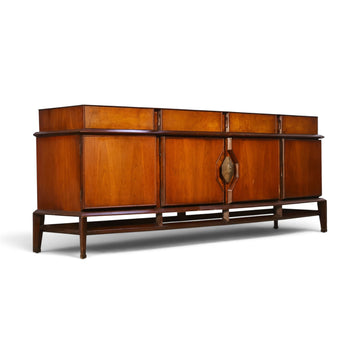
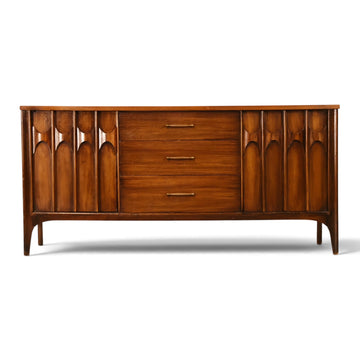
Florence Knoll Credenzas — Among her most architecturally resolved designs, the Knoll credenzas were produced in multiple configurations: single-pedestal and double-pedestal, with sliding doors, hinged doors, or combinations. Walnut, rosewood, and teak veneers were used across different eras. The attention to detail — precisely fitted doors, quality hardware, and seamless veneer work — distinguishes authentic Knoll production from later reproductions.
Executive Desk Collections — Florence Knoll's office furniture systems, including desks, return units, and storage components, were designed to work as integrated systems rather than individual pieces. The "Planning Unit" concept — a complete, coordinated office environment — was her most significant contribution to modern workspace design and influenced corporate interior design for decades.
Knoll Conference Tables — Large oval, rectangular, and boat-shaped conference tables with chrome or stainless bases and stone, glass, or wood tops. These are among the most collected of Florence Knoll's commercial designs; they appear regularly in high-end residential settings as dining tables.
The Parallel Bar Collection (Knoll Studio) — A family of sofas, chairs, and settees with a slightly more architectural feel than the Model 30/31 series, using parallel bar steel elements as a visible structural and aesthetic feature.
Authenticating Vintage Florence Knoll Pieces
Knoll's label history is a primary authentication tool. Florence Knoll-era production (roughly 1945–1965) typically bears Knoll Associates labels. Labels reading "Knoll International" indicate post-1965 production. The company was subsequently owned by various entities and the label evolved accordingly.
For upholstered pieces, look for a woven label sewn into the seat bottom or inside the back cushion. The label should credit Florence Knoll by name for her designs. On case pieces and desks, a paper or metal label is typically found on the back or underside.
Construction quality is the secondary authentication check. Florence Knoll pieces are built to extreme tolerances: door reveals should be perfectly even, veneer seams invisible or nearly so, chrome plating heavy and consistent. Pieces that show sloppy joinery, uneven gaps, or thin plating are almost certainly not authentic Knoll production.
Model numbers are the third authentication layer. Knoll maintained detailed records of its production and many pieces can be cross-referenced against published Knoll catalogs and the Knoll Archives.
Florence Knoll vs. "Knoll Style" Reproductions
The clean geometry of Florence Knoll's work makes it among the most reproduced MCM furniture. The Knoll sofa silhouette in particular is widely copied at every price point. Key differences between authentic Knoll production and reproductions: the weight and density of cushioning (authentic Knoll pieces are notably heavy), the quality of the chrome or stainless base (authentic pieces use substantial bar stock, not thin-walled tubing), and the precision of upholstery execution (Knoll's tightly fitted cushions are technically demanding to produce and reproductions typically show visible gaps or asymmetries).
The Knoll Planning Unit and Total Design
Beyond individual pieces, Florence Knoll's most important contribution was her concept of "total design" — the idea that a room's furniture should be conceived as an integrated whole rather than an assemblage of individual objects. This approach, realized most fully in Knoll's corporate interior projects of the 1950s and 1960s, influenced how American companies thought about their workplaces for an entire generation.
For collectors, this means that Florence Knoll pieces are often most powerful in context — a credenza paired with a matching desk, a sofa placed with side tables from the same system. Individual pieces are fully collectible on their own merits, but complete room groups command significant premiums and represent the fullest expression of her vision.
Further Reading
- Warren Platner Furniture Guide — Knoll's other great wire collection, championed by Florence Knoll.
- Vintage MCM Lounge Chairs Guide — Full buyer's guide to mid-century lounge seating, including Knoll models.
- Mid-Century Modern Credenza Guide — Overview of the most collected credenza makers and styles.
- What Is Mid-Century Modern? The Complete Style Guide — Full context for the MCM movement and its major figures.
- Shop Vintage Credenzas — Browse our current inventory of authenticated vintage credenzas.
- Mies van der Rohe Furniture Collector's Guide


