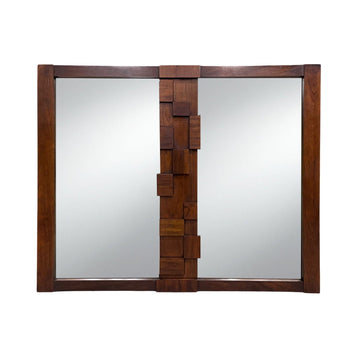

Who Was Kent Coffey?
Kent Coffey was an American furniture manufacturer based in Marion, North Carolina, that operated from 1920 through the early 1980s. Unlike many mid-century designers who built their reputations on individual creative vision, Kent Coffey was first and foremost a production manufacturer — a company that understood how to translate design ambition into beautifully made furniture at a scale that could reach American consumers nationwide. At its peak, the company was one of the most respected furniture producers in the country, known for the quality of its construction, the richness of its walnut and pecan veneers, and the restrained sophistication of its best lines.
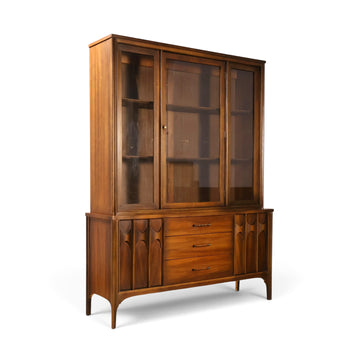
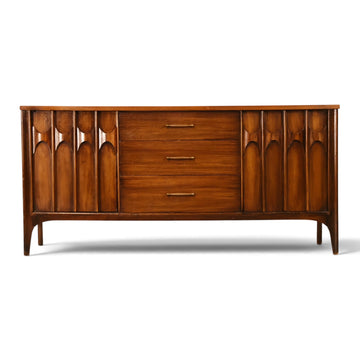
The company's crowning achievement — the line that collectors seek most eagerly today — was the Perspecta collection, introduced in the early 1960s. Perspecta represented a significant leap forward for Kent Coffey, marrying the clean horizontal lines of mid-century modernism with distinctive decorative elements that set it apart from every other line on the market. For collectors of American mid-century furniture, Perspecta occupies a special place: it is authentically designed, superbly built, and still findable at prices that reward careful shopping.
The Perspecta Line: Design and History
The Perspecta collection was introduced around 1960–1963 and quickly became one of Kent Coffey's signature offerings. The line was designed to bring a distinctly American interpretation of mid-century modernism to the bedroom suite market — and it succeeded brilliantly. Perspecta pieces share several distinctive visual characteristics that make the line immediately recognizable:
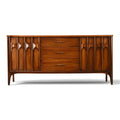
The Javelin legs. Perhaps the most iconic feature of Perspecta is its dramatic tapered legs, often called "javelin" legs by collectors. These are long, sharply tapered supports — sometimes in a contrasting lighter wood tone — that give the case pieces a sense of forward motion and lightness that distinguishes them from the blockier furniture of the 1950s. The contrast between the dark walnut veneer of the cases and the lighter leg material is visually striking.
Bookmatched walnut veneer. Perspecta drawer fronts and case surfaces feature carefully selected, bookmatched American black walnut veneer with exceptional grain figure. The wood was chosen for its visual consistency and richness. The deep, chocolate-brown tones with the natural variations of walnut grain give Perspecta pieces a warmth that photographs beautifully and ages gracefully.
Floating drawer pulls. Rather than traditional hardware, Perspecta pieces typically feature minimal or recessed drawer pulls that preserve the clean horizontal line of the drawer fronts. Some pieces use a narrow routed groove as a pull, keeping the surface completely uninterrupted.
Low, horizontal proportions. Following mid-century conventions, Perspecta case pieces — particularly the triple dressers and low chests — emphasize horizontal lines. Wide, low profiles with long runs of drawer fronts create a sculptural quality that works beautifully in both period and contemporary interiors.
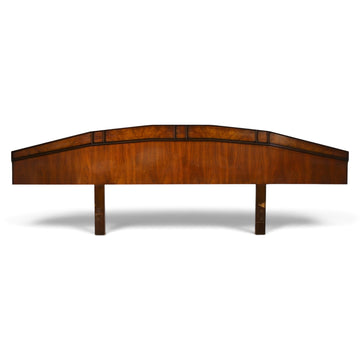
The Perspecta line included a full bedroom suite: bed frames, triple dressers, chests of drawers, nightstands, and armoires. Occasionally, credenzas and case pieces intended for other rooms appear under the Perspecta name as well, though bedroom furniture is by far the most common finding today.
How to Identify Authentic Perspecta Pieces
Authenticating Kent Coffey Perspecta furniture requires attention to labels, construction, and the signature design details described above. Here is a methodical approach:
Labels. Genuine Kent Coffey pieces carry a paper label typically located inside a drawer — often the top drawer — or on the back panel of case pieces. The label reads "Kent Coffey" with the line name (Perspecta) and sometimes a model number or date code. These labels are fragile and frequently deteriorate or are removed, so their absence doesn't rule out authenticity. Their presence, however, is a reliable confirmation.
The javelin legs. No other American furniture manufacturer used this exact leg form in combination with bookmatched walnut case furniture. If you see the distinctive long, tapered legs in a contrasting wood, you are almost certainly looking at Perspecta.
Construction quality. Kent Coffey Perspecta pieces are solidly built. Drawers should run smoothly on wooden or early nylon glides, with dovetailed corners on quality examples. The backs of pieces are typically hardboard or thin plywood — standard for the era — but the veneer on exposed surfaces should be consistent and well-matched.
Proportions. Perspecta pieces are long and low. A standard triple dresser is typically around 72 inches wide and only 32–34 inches tall. If proportions feel tall or boxy, the piece may be a different Kent Coffey line or an entirely different manufacturer.
Other Kent Coffey lines. Not all Kent Coffey furniture is Perspecta. The company produced many lines over its decades of operation, including the Continental, the Tableau, and various traditional and transitional styles. Collectors and decorators specifically seeking the mid-century modern aesthetic should focus on pieces bearing the Perspecta label or the characteristic javelin legs.
Collecting Perspecta: What to Look For
The most sought-after Perspecta pieces are the large triple dressers with mirrors, the low chests, and the credenzas. These pieces make the strongest visual statement and are most useful in contemporary interiors. Nightstands and smaller chests are common but less dramatically impactful on their own — they work best as part of a coordinated suite.
Condition is the single most important variable in Perspecta value. The walnut veneer, while beautiful, can be damaged by moisture, heat, or improper refinishing. Look for:
- Veneer lifting or bubbling, particularly at drawer edges and top surfaces
- Water rings or heat damage on top surfaces
- Replacement hardware that doesn't match the original minimal pulls
- Previous refinishing that has obscured the original walnut grain or darkened the wood unevenly
- Missing javelin legs (replacements are difficult to source authentically)
Pieces in original finish with intact labels and all original hardware represent the top of the market. Lightly cleaned, unrestored examples are most desirable for collectors who want authenticity. Professionally restored pieces with appropriate period-correct finishes can also command strong prices — but amateur refinishing significantly reduces value.
At Mod City Mad, we periodically source Kent Coffey Perspecta pieces as part of our curated selection of vintage mid-century modern dressers and credenzas. Our pieces are described with detailed condition notes and photographed accurately so buyers can assess condition before purchase.
Why Perspecta Matters Today
The Perspecta collection represents a convergence of factors that make it genuinely significant in American mid-century furniture history. It was designed during the height of American modernism's consumer moment — the early 1960s, when the aesthetic vocabulary of designers like George Nelson and Charles and Ray Eames was filtering into the mass market through manufacturers who understood both good design and good production. Kent Coffey was one of those manufacturers.
Today, Perspecta furniture offers collectors and decorators something increasingly rare: genuine mid-century American design at accessible prices, made with real walnut veneer and solid construction, in proportions that work beautifully in contemporary spaces. As the supply of original pieces gradually diminishes and awareness of the line grows among design-conscious consumers, Perspecta represents an attractive area for collectors who want quality, authenticity, and market upside.
Further Reading
If you're exploring American mid-century furniture broadly, these related guides from the Mod City Mad blog may be helpful: