

The short answer
- Solid walnut is walnut all the way through; veneer is a thin slice of walnut glued over a core such as plywood, particleboard or a plainer wood.
- Check the edges, the end grain, the underside and the drawers: veneer shows a seam or a different material, solid wood shows the same wood everywhere.
- Veneer is not a flaw. Cross-layered plywood cores move less with humidity, and veneer makes mirror-image grain patterns possible.
- What veneer changes is refinishing: it is thin, so it has to be sanded with care.
"Is it solid walnut?" is one of the questions we hear most about vintage dressers. It's a fair thing to ask, and the answer usually takes two minutes with a flashlight. Below is how to check a dresser yourself, what the answer actually means for you, and why a veneered mid century modern dresser can be every bit as good a buy as a solid one.
Solid wood and veneer: what the words mean
Solid wood means each part is cut from boards of that wood. If you scratch it, sand it or chip it, you find more of the same wood underneath.
Veneer is a thin sheet sliced from a log and glued onto a core. That core might be plywood, particleboard, fiberboard or a less expensive solid wood. On a vintage piece, the walnut you see on the top and drawer fronts may be veneer while the legs, edges and frame are solid. Many vintage pieces mix the two, so the better question is often "which parts are solid?" rather than "is it solid?"
Plenty of mid century furniture was built this way: a harder, better-looking wood laid over a plainer one. That's a normal construction method, not a shortcut.
Why mid century makers used veneer
Stability
Wood swells and shrinks as the humidity changes, and wide solid panels can cup, split or warp. Plywood is made by gluing thin layers with the grain running in alternating directions. Each layer holds back the movement of the next, so the finished panel moves far less than a single wide board. That's a real advantage on a long dresser top or a broad case side.
Matched grain
Veneer also allows decorative layouts that would be hard to get from solid boards. In a bookmatch, consecutive slices from the same log are opened like the pages of a book, so neighboring panels mirror each other. In a slip match, the slices are slid side by side so the pattern repeats. When you see a dresser top or a row of drawer fronts where the walnut grain mirrors perfectly from one side to the other, you're looking at one of the classic ways veneer is laid out.
Six ways to tell solid walnut from veneer
1. Follow the grain around the edge
Look at a corner of the top or the edge of a drawer front. On solid wood, the grain runs over the edge and carries on down the side as one continuous pattern. On veneer, the pattern usually stops at the edge, and you may see a thin line where the face sheet meets the core or an edge strip.
2. Read the end grain
The ends of a solid board show growth rings or open pores, and they line up with the grain on the face and match it in color. If the end looks like stacked layers (plywood) or a speckled, uniform material (particleboard or fiberboard), the face is veneer. One caution: some modern veneers imitate end grain, so treat this as one clue among several.
3. Compare the top to the underside and back
Pull the dresser out from the wall and look at the back panel and the underside. Solid pieces tend to show the same wood throughout. On veneered pieces these hidden areas often reveal the core material, unfinished, because nobody was meant to see them.
4. Open a drawer
Drawers are often built with less cosmetic care than the front, which makes them honest. Look at the edge of the drawer front, the sides, the bottom panel and the corners. Dovetail joints, the interlocking fingers at the corners, are a mark of well-made drawer construction. Staples, nails or plain glued corners point to a more basic build.
5. Look at any chips or worn spots
Damage tells the truth. A chip in solid walnut shows more walnut. A chip in veneer shows a different material underneath, often a lighter wood or the layered edge of plywood.
6. Don't rely on weight
People often lift a corner and judge by heft. That's not dependable: some engineered cores are heavy, and some solid woods are light. Use weight only alongside the other checks.
Shopping online? Ask these questions
Photos alone usually can't settle the question. When you buy from any dealer online, ask:
- Which surfaces are veneered, and which parts are solid?
- What is the core under the veneer?
- Can you send a photo of a drawer corner, the back panel and the edge of the top?
- Is any veneer chipped, lifting or missing?
Our guide to identifying and authenticating vintage mid century modern furniture covers labels, stamps and other clues to check at the same time.
Does it matter? What veneer means for you
For everyday use
For holding clothes and looking beautiful in a bedroom, a well-made veneered dresser does the job. A cross-layered core is built to resist the warping that wide solid panels can suffer, which is exactly what you want on a long dresser top.
For refinishing
This is where the difference is real. Veneer is thin, and a power sander can go through it quickly. When that happens, the grain and figure fade into a blurry patch. The right move is to stop sanding the moment the figure starts to thin. Small spots can sometimes be disguised by painting grain back in between coats of finish, but large ones cannot. Solid wood is more forgiving, because sanding just exposes more of the same wood.
So a veneered dresser can absolutely be refinished. It just needs careful hands. Our mid century modern restoration guide walks through the whole process.
How we handle it at Mod City Madness
Every piece we sell is offered as-is, in its current condition. If you'd rather have it refinished, you can add restoration when you buy by choosing the "Restored" option on the product page. Our restoration work is done in our New Jersey workshop: the old finish is removed, chips and scratches are repaired, the piece is sanded, stained and sealed in a satin lacquer, and drawers and doors are adjusted. Restoration usually takes four to eight weeks, and you'll get an estimate when you order.
Shop this look
A few walnut dressers in stock right now, each available as-is or with restoration added:
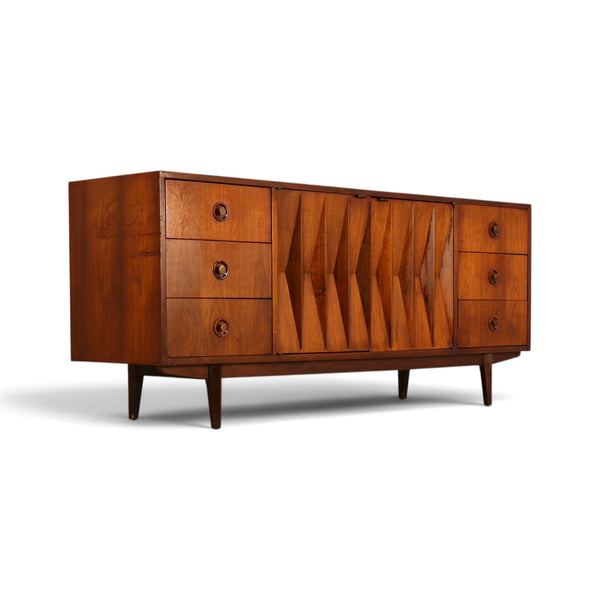
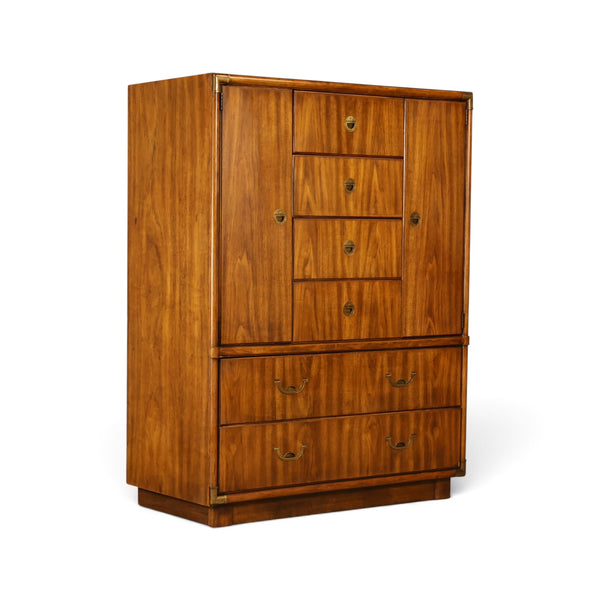
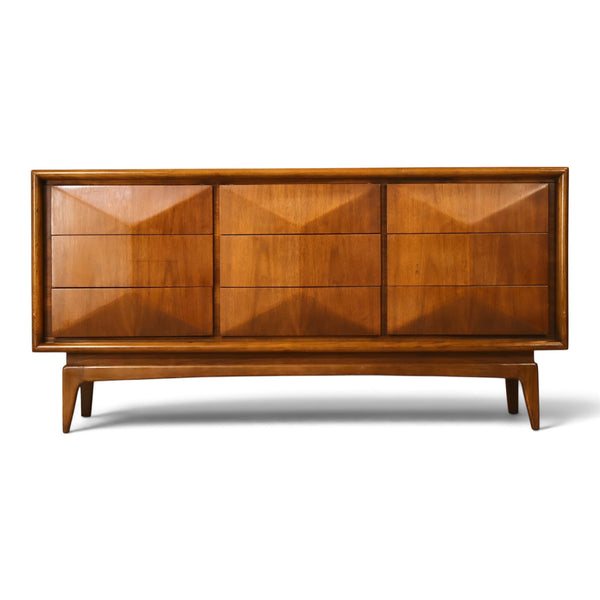
- United Furniture Diamond Front Highboy Dresser, 1960s, eight drawers with sculpted, faceted fronts.
- United Furniture 9 Drawer Keyhole Pull Lowboy Dresser, 1960s, a gentle bow front that shows off the movement in the walnut veneer.
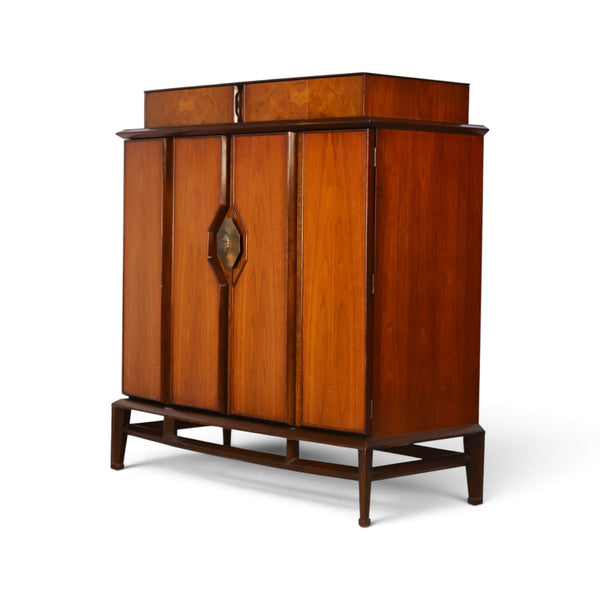
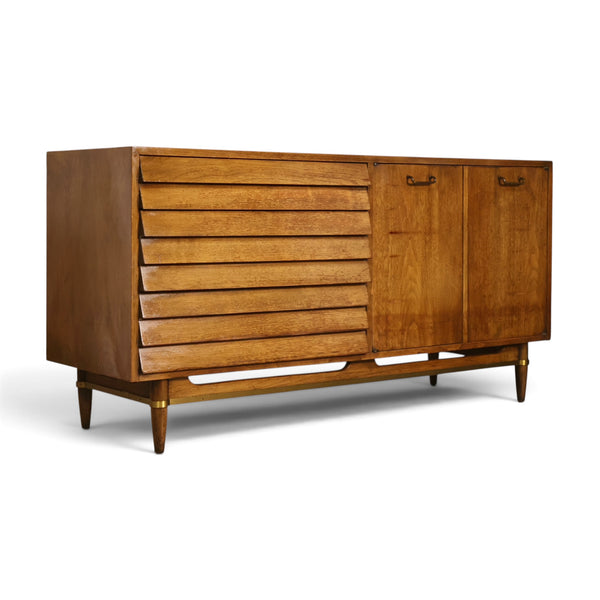
- Cavalier Highboy Dresser, 1960s, with a double-door top cabinet and brass-accented pulls.
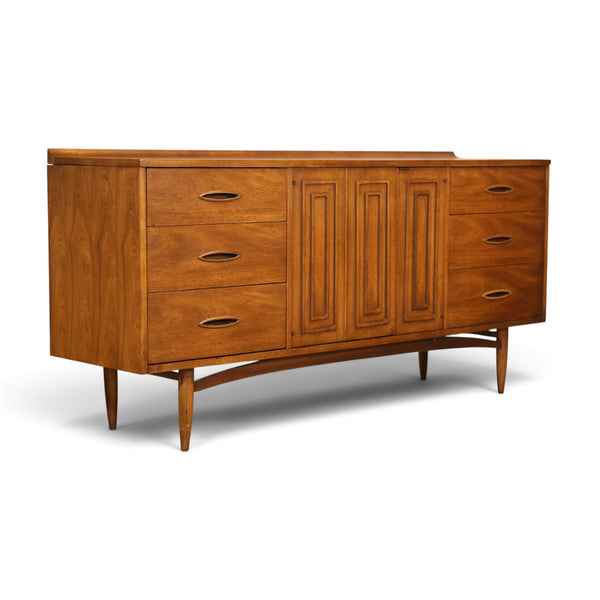
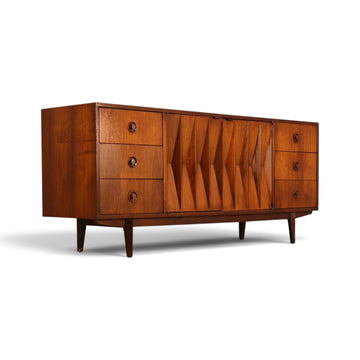
- Sculptural Atomic Style 6 Drawer Lowboy Dresser, 1960s, with hidden drawers behind sculpted panels.
Browse everything in our mid century modern walnut furniture collection or see all dressers and nightstands.
Own one? We buy and consign mid century furniture
If you have a walnut dresser or bedroom set you're ready to part with, solid or veneered, send us a few photos and we'll take a look.
Looking for something specific? We'll find it. Tell us the maker, size or style you want on our sourcing request page.
Common questions
Is a veneered dresser lower quality than a solid wood dresser?
Not by itself. Veneer over a cross-layered plywood core resists warping better than wide solid panels, and it allows matched grain patterns. Quality depends on the whole build: the core, the joinery and the condition.
Can a veneered mid century dresser be refinished?
Yes, as long as the veneer isn't too thin or badly damaged. It has to be sanded lightly and carefully, because sanding through veneer leaves a patch that is hard to repair.
What is the quickest way to check if a dresser is solid walnut?
Look at the edge of the top and the edge of a drawer front. If the grain wraps continuously around the edge and the end shows real growth rings that match the face, that part is solid. A seam, layers or a different material means veneer.
Is weight a good test for solid wood?
No. Some engineered cores are heavy and some solid woods are light, so weight should only back up what you see on the edges, back and drawers.