
Who Was Jack Cartwright?
Jack Cartwright is one of mid-century modern furniture design's great unsung heroes — an American designer whose Scandinavian-inflected sensibility helped bring sophisticated, architect-quality furniture into postwar American homes at an accessible price point. Working primarily for Founders Furniture (also marketed as Founders of Grand Rapids) from the late 1950s through the 1970s, Cartwright produced a body of work that collectors are only now beginning to fully appreciate.
Born and trained in the United States, Cartwright absorbed the lessons of Danish Modern design — the warmth of natural wood, the logic of clean lines, the respect for human proportion — and translated them into furniture that felt at home in a split-level ranch just as comfortably as a Manhattan loft. His pieces carry the elegance of Borge Mogensen or Hans Wegner without requiring an import premium.
Founders Furniture: The Company Behind the Name
Founders Furniture was a Grand Rapids, Michigan manufacturer that positioned itself as a mid-market alternative to premium European imports. Throughout the 1960s and early 1970s, the company hired designers who could execute Scandinavian-influenced lines using American production methods and domestic walnut — and Jack Cartwright was their star.
Founders pieces are typically marked with a branded tag or label reading "Founders Furniture" or "Founders of Grand Rapids." Some earlier pieces carry a foil label; later production used a paper tag stapled to the underside of drawers or the bottom of seat rails. Cartwright's own name sometimes appears on these labels, which is relatively rare for American production furniture of the era and adds significantly to collectibility.
Cartwright's Signature Style
If you've ever admired a piece of Founders furniture and thought "this looks almost Danish," there's a reason. Cartwright's hallmarks include:
- Solid walnut and walnut veneer construction — warm, dark grain that photographs beautifully and ages gracefully
- Tapered, angled legs — often with a slight outward splay that gives case pieces and seating a light, lifted quality
- Floating drawer faces — drawers that appear to hover slightly, creating shadow lines that add visual rhythm without ornamentation
- Caned or upholstered seating panels — chairs and sofas feature tight, high-quality upholstery over low-profile frames
- Modular thinking — shelving systems, sectional sofas, and wall units designed to combine and recombine
- Restrained hardware — simple brushed brass or oil-rubbed pulls that complement rather than compete with the wood
Most Collectible Jack Cartwright Pieces
Dining Sets
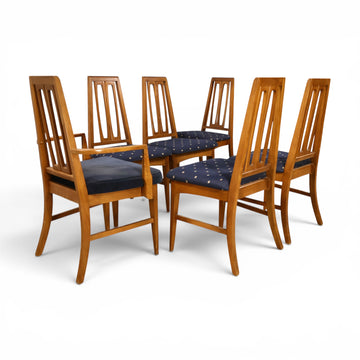
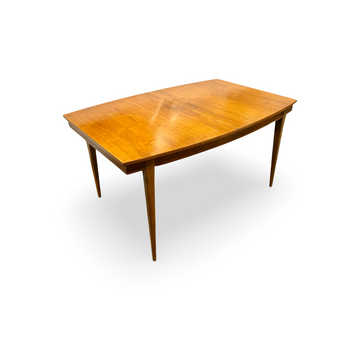
Cartwright's dining tables and chair sets are among his most sought-after designs. Look for extension tables with sculpted walnut bases and matching side chairs with angled walnut legs and either upholstered or caned backs. A complete set — table plus four to six chairs — commands the strongest prices and is increasingly hard to find intact.
Bedroom Suites
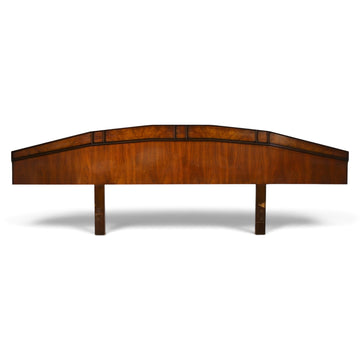
Cartwright designed some of the most elegant American production bedroom furniture of the 1960s. Dressers with floating drawer faces, low-profile platform beds, and tall chests with simple pulls are all desirable. A full suite in excellent original condition is a true find.
Seating
Lounge chairs, sofas, and sectionals bearing the Founders/Cartwright label have grown substantially in value. The tight upholstery over clean walnut frames has aged well, and reupholstery is straightforward given the simple construction.
Case Pieces and Storage
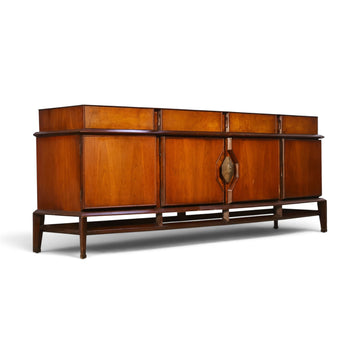
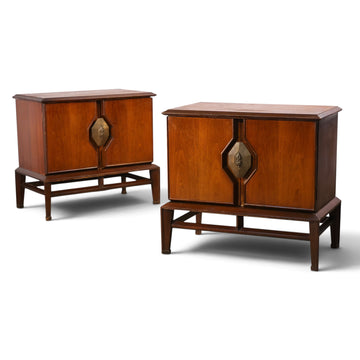
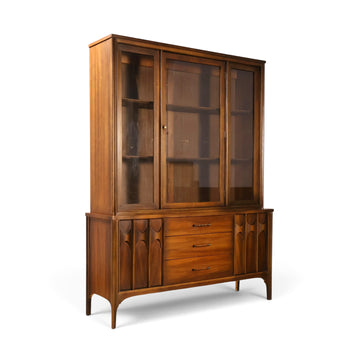
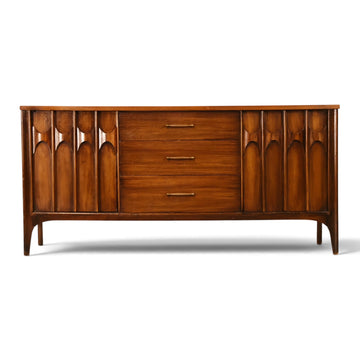
Credenzas, sideboards, and modular wall units are perhaps the most versatile Cartwright pieces for modern interiors. Long, low credenzas with splayed legs and tambour or panel doors are particularly desirable — they function as media consoles, dining room storage, or home office furniture equally well.
How to Authenticate Jack Cartwright Furniture
Authentication matters because Founders produced a large volume of furniture and not every piece was designed by Cartwright. Here's what to look for:
- Labels and tags — Check inside drawers, under seat rails, and on backing panels. Look for "Jack Cartwright" or "Designed by Jack Cartwright" in addition to the Founders name
- Construction quality — Cartwright pieces use solid walnut for legs and edge pieces, with quality veneer on flat surfaces. Joints are tight; drawers operate smoothly on wooden runners or early nylon guides
- Design coherence — Authentic Cartwright pieces have a consistent visual logic. Proportions feel considered; nothing is arbitrary
- Period-correct hardware — Original hardware is solid metal, not hollow or plastic. Replacement hardware is common; original hardware adds value
- Catalog research — Founders published detailed catalogs through the 1960s and 70s. Matching a piece to a catalog page provides strong authentication
Condition, Restoration, and Value
Jack Cartwright furniture holds value well across a range of conditions, but condition drives price significantly.
Original finish in excellent condition commands the highest premiums. The deep walnut tones Cartwright favored are stunning when properly preserved — light cleaning and a quality paste wax are often all that's needed.
Pieces needing refinishing are still valuable, especially if the structure is sound, veneer is intact, and hardware is original. A professional refinish by someone experienced with mid-century furniture can restore near-original appearance.
Seating reupholstery is expected on 60-year-old pieces. Quality reupholstery in a period-appropriate material — boucle, wool, leather — neither adds nor significantly detracts from value.
How Jack Cartwright Compares to Other MCM Designers
- vs. Danish designers (Wegner, Mogensen, Finn Juhl) — Cartwright shares the aesthetic DNA but was produced for the American market. Today he often represents better value-per-quality than imported Danish pieces
- vs. other American MCM designers — Compared to Milo Baughman or Vladimir Kagan, Cartwright was more restrained and Scandinavian-influenced. Different aesthetic, equally strong quality
- vs. other Founders designers — Not all Founders pieces have the Cartwright pedigree. Verified Cartwright attribution carries a meaningful premium over generic Founders production
Caring for Your Jack Cartwright Furniture
- Keep pieces away from direct sunlight, which bleaches walnut and causes uneven fading
- Maintain humidity between 40–60% to prevent wood movement and veneer lifting
- Clean with a barely damp cloth; avoid water pooling near joints
- Apply a quality paste wax two to three times per year
- Tighten any loose joints promptly — small problems in wood furniture grow quickly
Frequently Asked Questions
Is Jack Cartwright furniture worth buying?
Yes — it represents some of the best value in American mid-century modern furniture. The design quality rivals much more expensive imports, and the market has not yet fully priced in Cartwright's growing reputation among serious collectors.
How do I know if a Founders piece was designed by Jack Cartwright?
Look for a label crediting "Jack Cartwright" specifically. Cross-reference with vintage Founders catalogs available through collector communities and auction house archives.
Is Founders Furniture still in business?
No — Founders Furniture ceased production in the 1980s. All Jack Cartwright pieces in circulation are vintage originals, which contributes to their collectibility.
Where can I find Jack Cartwright furniture?
Estate sales in the Midwest — particularly Michigan, Ohio, and Illinois — tend to yield the best finds. Online marketplaces and vintage dealers specializing in American MCM are your best bet outside the Midwest.
Shop Jack Cartwright Furniture at Mod City Madness
We specialize in authenticated mid-century modern furniture with an expert eye for quality and provenance. Browse our current Jack Cartwright furniture collection — each piece is carefully vetted, accurately described, and available as-is or professionally restored.
Want to explore related designers? See our guides to Vladimir Kagan, Milo Baughman, and Danish Modern furniture.


