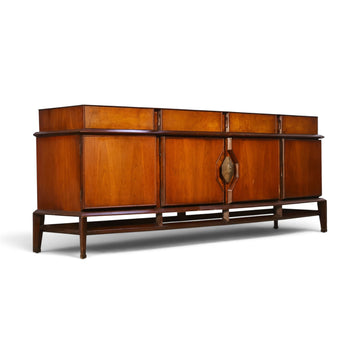
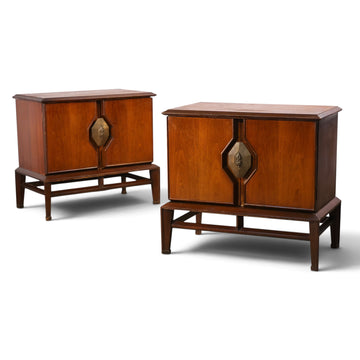
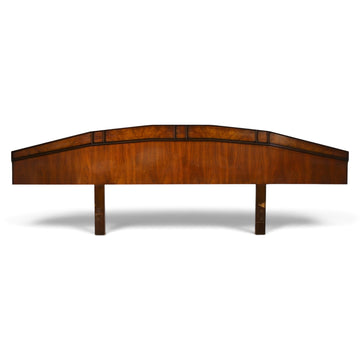
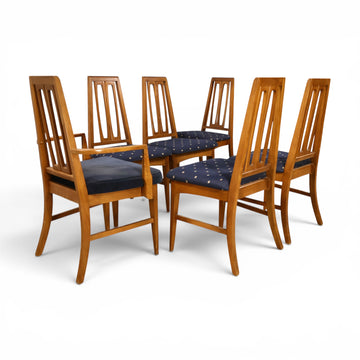

Will it fit your wall?
Type your wall width in inches. Every piece shows how it fits, and we remember it as you shop.
No products found
Use fewer filters or remove all
T.H. Robsjohn-Gibbings
Designer Profile
T.H. Robsjohn-Gibbings
1905–1976 | Greco-British Modernist
Biography
Terence Harold Robsjohn-Gibbings was born in 1905 in London and trained as an architect before being drawn into the worlds of antiques, interior decoration, and eventually furniture design. His early career took him through the London antiques trade and brought him into contact with some of the most fashionable collectors and decorators of the era. By the time he emigrated to the United States in the 1930s, he had already developed an unusually sharp eye for the classical tradition and a deeply skeptical view of modernist doctrine.
Establishing himself in New York, Robsjohn-Gibbings quickly became one of the most sought-after interior designers of the 1930s and 1940s. His client list included industrialists, socialites, and Hollywood figures, and his rooms were celebrated for their calm, luminous quality — stripped of Victorian fussiness but never cold or austere. He worked on a grand scale, designing complete environments where every element from the upholstery to the doorknobs was considered.
His furniture design career began in earnest through his collaboration with the Widdicomb Furniture Company of Grand Rapids, Michigan, which began in 1943 and lasted more than a decade. The resulting line, produced under the name "Robsjohn-Gibbings for Widdicomb," became one of the most celebrated American furniture collections of the postwar years. The pieces were rooted in classical proportion — the tripod leg, the klismos chair silhouette, the subtle saber — but executed with American directness and a commitment to quality materials that made them entirely at home in modern interiors.
"Good design is not a style. It is a way of thinking — of respecting the human body, the nature of materials, and the purposes things are meant to serve."
— T.H. Robsjohn-Gibbings
Robsjohn-Gibbings was also a writer of unusual wit and polemical energy. His 1944 book Goodbye, Mr. Chippendale was a scathing attack on American decorating taste and the reverence for antiques — paradoxical given his own antiques background, but revealing of a mind that preferred to demolish received wisdom. His subsequent books, including Homes of the Brave and Mona Lisa's Mustache, extended his critique to modernism itself, which he found as dogmatic and inhuman as the Victorian excess he had earlier attacked.
In the late 1950s, Robsjohn-Gibbings relocated to Athens, Greece, where he pursued his lifelong passion for ancient Greek design. He collaborated with the Greek craftsmen at Saridis, producing a remarkable line of furniture based on ancient prototypes — klismos chairs, kline beds, thronos — that were scholarly in their research but intensely livable in execution. This final chapter of his career produced some of the most beautiful furniture of the twentieth century and has become increasingly recognized by collectors and museums.
He died in Athens in 1976, leaving behind a body of work that spans interior design, furniture, and critical writing — an unusually complete creative legacy from one of the great contrarians of American modernism.
Design Approach & Style
Robsjohn-Gibbings occupied a singular position in mid-century American design — deeply classical in his references yet thoroughly modern in his execution. Where the mainstream modernists looked to the machine and to abstraction, he looked to ancient Greece, to the proportional logic of the klismos chair and the tripod table, forms that had endured not through inertia but because they worked. He believed that the best furniture expressed the ergonomics of the human body and the logic of materials, and that these principles had been worked out most completely by the ancient Greeks.
The Widdicomb furniture shows this sensibility at its most commercially accessible. Pieces are characterized by slender, tapering legs — often with a subtle outward splay — beautifully resolved joints, and upholstery that covers forms of genuine sculptural elegance. The palette runs to warm walnuts and blond woods, and the proportions are consistently generous without being heavy. There is nothing ostentatious about these pieces; their quality is the quiet kind that reveals itself slowly.
The Saridis pieces from his Greek period are more archaeologically precise and more overtly luxurious — executed in ebonized or gilded wood with cane and leather — but share the same fundamental commitment to proportion, material honesty, and the human figure as the measure of all things. Together, the two bodies of work constitute one of the most coherent and deeply considered design visions of the twentieth century.
Collecting & Authentication
The most collectible Robsjohn-Gibbings pieces are from the Widdicomb production of the 1940s and 1950s, which can be identified by paper labels typically found on the underside of seat rails or drawer bottoms. The labels read "Robsjohn-Gibbings for Widdicomb" and often include a model number. Many pieces also carry a metal tag with the Widdicomb name. The furniture was sold through high-end department stores and specialty retailers, so it arrived in homes across the country and can still surface in estate sales throughout the Midwest and East Coast.
Key forms to look for include the klismos-inspired chairs with their distinctive saber-leg profile, the low rectangular sofas with exposed wooden frames, the tripod occasional tables, and the case pieces — dressers, chests, and credenzas — with their characteristic graduated drawer arrangements and understated hardware. Condition of the original finish matters considerably; Widdicomb used high-quality walnut veneers that refinish well, but original surfaces in good order command a premium.
The later Saridis pieces, produced in Greece from the late 1950s onward, are rarer in the American market and typically reach auction at specialist houses. They carry Saridis labels and are sometimes accompanied by documentation of their ancient prototypes. Museum collections including the Metropolitan Museum of Art hold examples of both the Widdicomb and Saridis work, and the Met's Greek and Roman galleries include a noted installation of the Saridis klismos chairs.
At ModCityMad, our Robsjohn-Gibbings pieces are authenticated through label research, period catalog comparison, and wood analysis where appropriate. Every piece comes with our written condition report and provenance documentation.
Frequently Asked Questions
What makes Robsjohn-Gibbings furniture so enduring?
His furniture is rooted in principles of proportion and ergonomics that transcend style — the same logic that made the ancient klismos chair work still makes his adaptations of it work today. There is no historical pastiche, just an extraction of what is structurally and visually correct about classical forms, translated into mid-century American production.
How do I identify authentic Widdicomb pieces?
Look for paper labels reading "Robsjohn-Gibbings for Widdicomb" on the underside of seat rails, drawer bottoms, or the backs of case pieces, often accompanied by a model number. Metal Widdicomb tags are also common. Period catalogs are invaluable for cross-referencing model numbers and original configurations.
What is the difference between Widdicomb and Saridis pieces?
The Widdicomb pieces (1940s–1950s) are the commercially produced American line — accessible, beautifully proportioned, and widely available to collectors. The Saridis pieces (late 1950s–1970s) were produced in Athens, are more overtly based on specific ancient Greek prototypes, and are considerably rarer on the American market. Both are museum-quality; the Saridis work tends to command higher prices when it appears.
Are his pieces a good investment?
Robsjohn-Gibbings remains somewhat undervalued relative to his historical importance and the quality of the work. His pieces are consistently well-made and beautiful, and interest from museum curators and design historians has grown steadily. As with any vintage furniture, buy what you love and can live with — but the fundamentals here are strong.
Explore More Designers
Discover the Full ModCityMad Collection
Explore more vintage pieces from our full roster of mid-century modern designers.