
The Credenza: The Most Versatile Piece in Mid-Century Modern Design
Few pieces of furniture have seen a more dramatic rise in collector interest over the past two decades than the mid-century modern credenza. Once dismissed as surplus office furniture, the long, low storage cabinet has become one of the defining symbols of MCM interior design — and one of its most competitive categories on the secondary market. This guide covers the major credenza styles, the most important makers, dimensions and practical considerations, and what separates a good buy from a great one.
What Is a Credenza?
The term "credenza" originally referred to a side table used in Italian dining rooms for the pre-tasting of food (from the Italian word for "belief" or "trust"). In modern furniture parlance, it describes any long, low case piece — typically between 54 and 84 inches wide and 28 to 32 inches tall — used for storage and display. In mid-century design, the credenza replaced the traditional sideboard in dining rooms and evolved into the dominant storage form for living rooms, offices, and bedrooms.
Credenzas are distinguished from sideboards primarily by their lower profile, cleaner lines, and the variety of internal configurations: sliding doors, hinged doors, open shelves, drawers, and combinations thereof. The best MCM credenzas integrate these functions invisibly — a wall of clean wood faces that open to reveal precisely organized storage inside.
The Major Styles of MCM Credenzas
Scandinavian floating/wall-mounted credenzas — Perhaps the most coveted style: a long case piece mounted on a wall bracket or recessed supports, appearing to float above the floor. Pioneered by Danish makers and designers including Poul Cadovius (whose Royal System wall units set the template), these pieces create maximum visual lightness. Authentic floating credenzas are harder to mount safely than they appear; proper wall anchoring is essential.
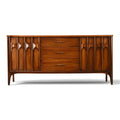
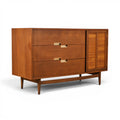
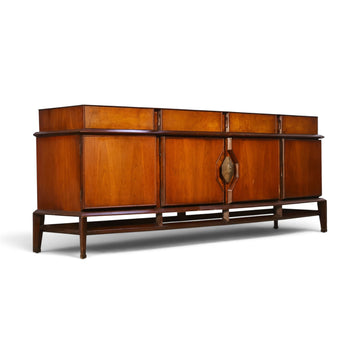
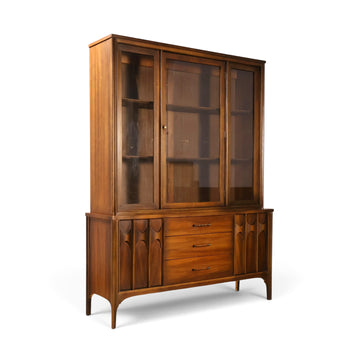
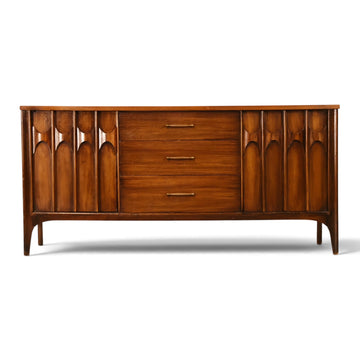
Walnut case pieces on hairpin or tapered legs — The dominant American MCM credenza form, produced in enormous quantities by Lane, Drexel, Bassett, Broyhill, and dozens of smaller manufacturers. Typically in walnut veneer over particle board or plywood cores, with tapered solid walnut or metal legs. Quality varies significantly across manufacturers; the best examples use matched veneer panels, solid wood edge banding, and dovetailed drawer construction.
Danish rosewood credenzas — Produced primarily for the export market in the 1950s–1970s, these represent the pinnacle of MCM case piece construction. Rio rosewood (now CITES-restricted) was used extensively before the 1973 CITES regulations; later Danish production shifted to teak and other materials. Rosewood credenzas command significant premiums and are among the most faked pieces in the category.
Office credenzas — Produced by Knoll, Herman Miller, Steelcase, and other commercial furniture makers for the corporate market. Often in steel with laminate or wood veneer tops, or in all-wood with integrated file storage. Florence Knoll's credenza series is the most collected in this category. Office credenzas tend to be more utilitarian in finish than residential pieces but are extremely well-built and often available at lower prices than equivalent residential designs.
Lacquered and painted credenzas — A smaller category but significant: some Italian and Scandinavian makers produced credenzas in high-gloss lacquer finishes, often in black, white, or bold colors. These require more careful maintenance but create dramatic visual impact.
The Most Collected Credenza Makers
Lane Furniture produced the most widely available and consistently good-quality American MCM credenzas. The Staccato, Perception, and Acclaim lines are particularly sought. Lane's date code system (stamped on the back panel) allows precise dating. Lane credenzas typically use walnut veneer over solid wood frames with solid walnut legs — better construction than most competitors at the same price point.
Drexel's Declaration line (designed by Kipp Stewart and Stewart MacDougall in 1958) is among the most refined American MCM case piece designs. The credenzas feature sliding panels, integrated hardware, and exceptional veneer matching. The full Declaration suite — credenza, dining table, and chairs — is the most complete expression of the design.
Paul McCobb's Planner Group and Linear Group pieces for Calvin Furniture include some of the most architecturally refined American credenzas, with strong Shaker-influenced proportions and exceptional build quality.
Florence Knoll's credenza series remains in production (through Knoll Studio) and vintage examples are actively collected. The single-pedestal and double-pedestal variants with sliding or hinged doors are the most common configurations. Labels should identify "Florence Knoll" as designer.
George Nelson designed multiple storage wall systems and credenzas for Herman Miller, including the famous Comprehensive Storage System (CSS) and various case pieces. Nelson credenzas often appear on thin steel hairpin legs and feature distinctive hardware and proportions.
Danish unknown makers — A huge portion of the Danish credenza market consists of well-made pieces by smaller Danish workshops that exported extensively to the US and UK. These pieces often lack designer labels but show exceptional craftsmanship. The Denmark export certification label (a round paper label) confirms Danish manufacture; without a maker label, attribution depends on style and construction analysis.
Dimensions and Practical Considerations
Standard MCM credenzas range from 54 to 84 inches in width, with 68–72 inches being the most common "full-size" format. Depth is typically 17–20 inches for American pieces; Danish examples run slightly shallower at 14–18 inches. Height ranges from 28 to 32 inches for American floor-standing pieces; Danish floating credenzas are typically mounted at 24–36 inches from floor level depending on context.
For dining room use, a credenza should be roughly counter height (33–36 inches) when used as a buffet; standard 28–30 inch MCM credenzas read as too low for comfortable buffet service unless supplemented with a tray or risers. In living rooms, the lower profile is generally preferable — a 28-inch credenza below a television or artwork sits well visually.
Door configuration matters practically: sliding doors are standard on most MCM credenzas and require no clearance to open but provide only half-width access to the interior at a time. Hinged doors require clearance but give full access. For frequently accessed storage, hinged doors are more functional; for display shelving accessed occasionally, sliding doors are fine.
What to Check When Buying a Vintage Credenza
Veneer condition is the first thing to assess. MCM credenzas use veneer over substrate — wood veneer (typically 1/28" to 1/16" thick) over plywood or particle board cores. Look for lifting veneer edges (especially on top surfaces and around drawers), bubbling, or discoloration from water damage. Minor edge lifting can be reglued; large bubbled areas or water-damaged veneer sections are much more difficult to repair invisibly.
Check the legs. Tapered solid wood legs are common and can be repaired; hairpin and other metal legs may show rust or have been bent. Replacement legs are available from specialty retailers but must match the original in length and attachment method to preserve the piece's proportions.
Test every door and drawer. Doors should slide or swing smoothly with no binding. Drawers should move freely and close flush. Original hardware should be intact; replacement hardware that doesn't match the original type affects both value and appearance significantly.
Look at the back panel. Most credenzas have a thin hardboard or plywood back panel. Check this for damage, evidence of moisture intrusion, or signs that the piece was ever built in (holes drilled for plumbing, electrical, etc. — common in office pieces repurposed from commercial settings).
Further Reading
- Mid-Century Modern Credenza Guide — Our earlier guide covering credenza styling and pairing.
- Vintage Lane Furniture Collector's Guide — The most comprehensive American MCM credenza maker.
- Drexel Furniture Collector's Guide — Declaration and other Drexel credenza lines.
- Florence Knoll Furniture Collector's Guide — Office credenzas and the Knoll design legacy.
- Shop Vintage Credenzas — Browse our current inventory of authenticated vintage credenzas.