
Why Vintage Dining Chairs Are Among the Best MCM Investments
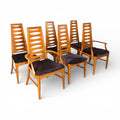
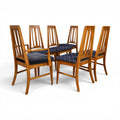
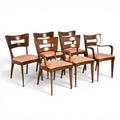
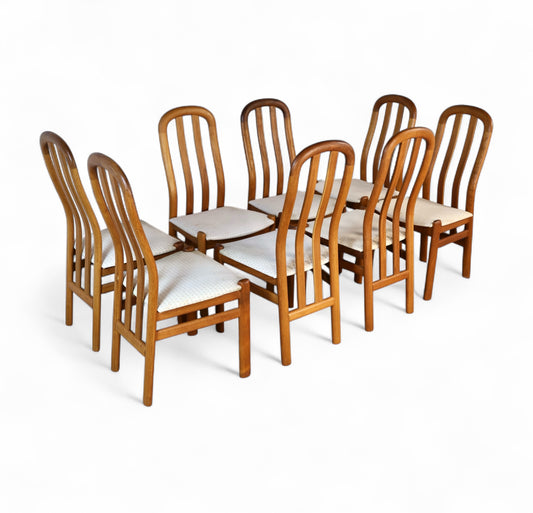
Vintage mid-century modern dining chairs occupy a unique position in the collector market: they're functional, beautiful, and available at virtually every price point from a few hundred dollars to many thousands. Unlike large case pieces, dining chairs are easy to ship, easy to mix and match, and immediately useful in any home. This guide covers the major categories of vintage MCM dining chairs, the most collected designers and manufacturers, what to look for when buying, and how to build a cohesive set from mismatched pieces.
The Major Categories of MCM Dining Chairs
Scandinavian solid wood chairs — The category most strongly associated with mid-century Danish and Swedish design. Characterized by solid teak, rosewood, or beech frames with either solid wood seats or upholstered seat pads. Hans Wegner's Wishbone chair (Carl Hansen & Søn), Arne Jacobsen's Series 7, and Børge Mogensen's designs are the most collected examples. These chairs age well, are highly repairable, and have strong secondary markets.
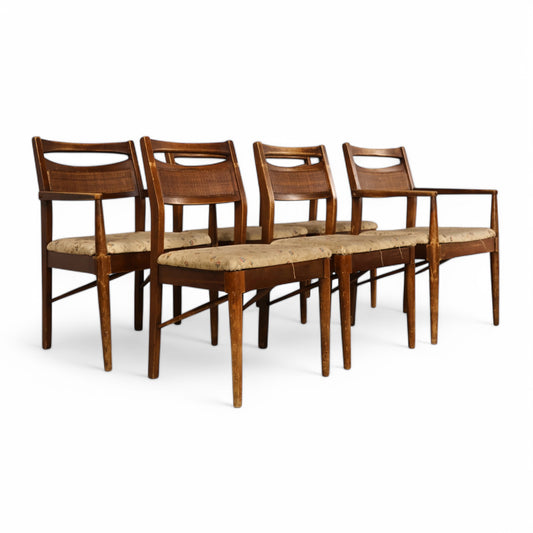
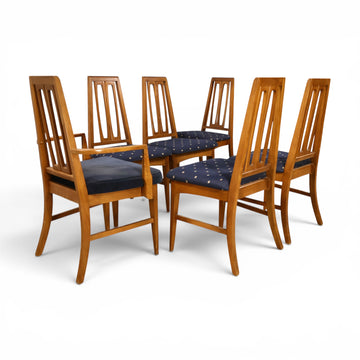
American manufacturer dining chairs — Produced by companies like Heywood-Wakefield, Broyhill, Lane, Bassett, and Thomasville in large volumes for the American mass market. Typically in birch, maple, or walnut, with or without upholstered seats. More affordable than Danish modern equivalents and underappreciated by comparison — excellent value for buyers who want the MCM look without Scandinavian price premiums.
Molded plastic and fiberglass shell chairs — The great democratic chairs of mid-century modernism: Charles and Ray Eames' shell chairs on wire, dowel, and rocker bases; Eero Saarinen's Tulip chair; and Arne Jacobsen's Ant and Series 7 (in both fiberglass and molded plywood versions). Eames shells on rope-edge bases command premiums; later production on H-base or wire base is more affordable.
Upholstered dining and side chairs — Designs by Knoll, Herman Miller, and Milo Baughman, typically with padded or fully upholstered seats and backs on chrome or wood frames. More formal and more maintenance-intensive than wood chairs, but often dramatically more comfortable for extended seating.
Metal-framed dining chairs — Bertoia's wire chairs, Knoll's Nelson Swag Leg chairs, and various tubular steel designs. Highly graphic and architectural; often used in commercial settings originally. The Bertoia Side Chair in particular has been in continuous production since 1952 and is available both vintage and new.
The Most Collected Vintage Dining Chair Designers
Hans Wegner designed over 500 chair variants during his career, many of which work well at a dining table. The Wishbone (Y-Chair), Round Chair, and Flag Halyard are the most famous, but the CH23, CH24, and Peacock Chair all appear regularly at dining tables in collector homes. Authentic Wegner pieces should be labeled by their manufacturer (Carl Hansen, PP Møbler, or Getama depending on design).
Arne Jacobsen's Series 7 (also called the 3107 or Butterfly chair) is one of the best-selling furniture designs in history. Originally produced in molded wood veneer, it remains in production by Fritz Hansen. Vintage examples from the 1950s–1970s show more pronounced curves and sometimes more variation in veneer selection than contemporary production. The Ant Chair (Series 3) is the sleeker, three-legged predecessor.
Charles and Ray Eames created the Plastic Armchair (PAC) and Plastic Side Chair (PSC) in fiberglass-reinforced plastic starting in 1950 — the first mass-produced plastic chairs and among the most widely collected MCM designs. Early production (1950–1955) is identifiable by the rope-edge detail along the seat rim. Later production has a smooth rim. Bases include the Eiffel Tower wire base, H-base, dowel base, rocker, and rocking-wire base, among others.
Eero Saarinen's Tulip chair (Knoll, 1956) is immediately recognizable: a single pedestal base in cast aluminum with a molded fiberglass shell. It was designed specifically to eliminate the "slum of legs" Saarinen saw under dining tables. Authentic vintage Knoll Tulip chairs are labeled accordingly; numerous reproductions exist at every quality level.
Børge Mogensen's Spanish Chair and various ladder-back designs are among the most livable Danish modern chairs — robust, practical, and beautiful. His shaker-influenced pieces for FDB Møbler are particularly undervalued relative to their quality.
Building a Set from Mismatched Chairs
Matching vintage dining sets are increasingly rare and increasingly expensive. Many collectors embrace intentional mismatching — building a table setting from related but non-identical chairs. The most successful approaches are: all-same-designer in different configurations (e.g., Wishbone side chairs with Wishbone armchairs at the heads), same-era chairs in complementary materials (teak and walnut at the same table), or chairs with related visual profiles paired with contrasting materials (all curved-back chairs in different woods).
Avoid mixing chairs of radically different seat heights — a 2-inch discrepancy in seat height at the same table is extremely uncomfortable. Standard dining table height is 30 inches; standard dining chair seat height is 17–19 inches. Verify seat height before buying any chair you plan to use at a specific table.
What to Check When Buying Vintage Dining Chairs
Structural integrity is the first priority: check all joints for looseness or play, particularly where legs meet seat rails. On wood chairs, a small amount of movement in well-used chairs is normal; significant wobble indicates joints need to be re-glued. This is a manageable repair but can be expensive if every joint needs regluing.
On upholstered seats, check the foam and fabric condition separately. Old foam compresses and flattens, causing the seat to feel thin and uncomfortable; replacing foam is relatively inexpensive. Fabric reupholstery costs more but completely transforms a chair. A structurally sound chair with failed upholstery is often excellent value.
On fiberglass and plastic shells, check carefully for cracks, especially along the seat rim and around the base attachment points. Small cracks can be stabilized; larger cracks running through structural areas are significant problems. Check the underside of the shell for damage not visible from the seat side.
On metal-framed chairs, check all welds and joints for integrity, and examine chrome or powder-coat finishes for rust spots, bubbling, or flaking. Surface rust on chrome can often be treated; rust that has penetrated to the steel beneath is more serious.
Seat Height and Ergonomic Considerations
One practical consideration that catalog photos don't convey: vintage MCM chairs tend to have lower seat heights than contemporary dining chairs. A Wegner Wishbone chair has a seat height of approximately 17.5 inches; many contemporary dining chairs run 18.5–19.5 inches. If your dining table has a fixed height, this matters: a lower chair puts the table surface at mid-chest rather than waist height for a seated adult, which is uncomfortable for extended meals.
If pairing vintage chairs with a contemporary table, verify seat heights. If pairing a vintage table with vintage chairs from the same era, they typically work correctly together since both were designed to the standards of the same period.
Further Reading
- Hans Wegner & Danish Modern Furniture Guide — Deep dive into Wegner's most important chair designs.
- Vintage MCM Lounge Chairs Guide — For when you want seating beyond the dining room.
- Mid-Century Modern Dining Room Guide — Full guide to designing an MCM dining space.
- How to Authenticate Vintage MCM Furniture — Verification techniques for any MCM purchase.
- Shop Vintage Dining Chairs — Browse our current inventory of authenticated vintage dining chairs.