
Who Was Jens Risom?
Jens Risom (1916–2016) was a Danish-American furniture designer who played a pivotal role in bringing Scandinavian design sensibilities to postwar America. Born in Copenhagen and trained at the Copenhagen School of Arts and Crafts under the legendary Kaare Klint, Risom emigrated to the United States in 1941 with little more than his education and an extraordinary eye for form. His timing was fortuitous: America was hungry for a new aesthetic, and Risom was perfectly positioned to deliver it.
Unlike many of his contemporaries who pursued bold sculptural statements, Risom was committed to a quieter, more functional elegance. He believed that good design should feel natural in any room — that furniture should invite use rather than demand attention. That philosophy, rooted in the Danish humanist tradition, made his work both timeless and commercially accessible at a moment when American consumers were redefining how they wanted to live.
The Knoll Collaboration: 1941–1946
Shortly after arriving in New York, Risom met Hans Knoll, a German-born entrepreneur who was launching what would become one of the most influential furniture companies in American history. The two men struck an immediate creative partnership. In 1942, they produced the first Knoll catalog together — a catalog that introduced fifteen Risom-designed pieces to the American market.
Wartime material shortages forced Risom to be inventive. With quality wood scarce and upholstery fabric heavily rationed, he turned to surplus military webbing — the same cotton and nylon strapping used in parachutes and cargo nets — to create the seats and backs of his chairs. The result was a range of lightweight, elegantly simple pieces that looked as though they had always belonged in a modern American living room. The most celebrated of these, the Risom Lounge Chair (later catalogued as model 654W), remains an icon of mid-century design.
Risom left Knoll in 1946 to found his own firm, but his Knoll-era pieces — produced in relatively small numbers during wartime — are among the most sought-after of his work. Look for the original Knoll label or webbing stampings when evaluating these early pieces.
Jens Risom Design, Inc.: 1946–1970
After departing Knoll, Risom established Jens Risom Design, Inc. in New York City. The company became known for producing beautifully crafted, solid-wood furniture aimed at corporate and residential markets. Where many postwar designers were seduced by plastics and industrial laminates, Risom remained committed to solid American walnut, cherry, and teak — materials he felt had an honesty and warmth that composites could never replicate.
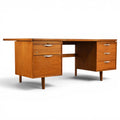
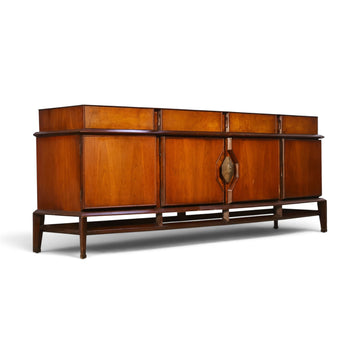
Through the late 1940s, 1950s, and 1960s, Jens Risom Design produced an expansive catalog: lounge chairs, dining chairs, benches, credenzas, desks, bookcases, and complete bedroom suites. His corporate clients included some of the most prestigious offices in America, which meant his pieces were produced in significant quantities — making them more findable today than the rarer Knoll-era work, though no less desirable.
Risom sold the company in 1970 to the Dictaphone Corporation, and the brand passed through several subsequent owners. Production quality declined noticeably after the sale, and collectors generally seek pieces made before 1970 for their superior craftsmanship and wood selection.
Signature Design Elements
Risom's furniture is immediately recognizable to trained eyes, though it wears its intelligence quietly. A few hallmarks to look for:
Material honesty. Risom used solid wood — not veneer over particleboard — for structural and visible surfaces. American black walnut is by far the most common wood in his designs, chosen for its rich grain and exceptional workability. Cherry and teak appear in smaller production runs.
Exposed joinery. Risom didn't hide how his furniture was put together. Mortise-and-tenon joints, through-tenons, and visible dovetails are characteristic of his case pieces. These details signal quality construction and help distinguish genuine Risom from later imitations.
Tapered legs. Whether square or round in section, virtually all Risom seating and case piece legs taper toward the floor — a design decision that simultaneously reduces visual weight and echoes the Danish tradition of making furniture feel as though it has just landed lightly on the ground.
Webbing seats. The early Knoll-era pieces used surplus military webbing. Later Jens Risom Design pieces often used woven leather, cane, or upholstered cushions, but webbing remained a recurring motif throughout his career.
Restrained ornamentation. There is almost no decorative carving, applied molding, or surface embellishment on Risom pieces. The beauty comes entirely from proportion, wood grain, and the play of light across gently curved surfaces.
How to Identify Authentic Jens Risom Pieces
Identifying genuine Risom pieces requires attention to labels, construction, and provenance. Here is what to look for:
Labels and stamps. Knoll-era pieces (1942–1946) may carry an early Knoll Associates label. Post-1946 pieces produced by Jens Risom Design carry a paper label — typically affixed to the underside of seats, the back of case pieces, or inside drawers — reading "Jens Risom Design" with a model number and sometimes a date code. These labels can deteriorate significantly with age, so their absence doesn't rule out authenticity, but their presence is strong confirmation.
Model numbers. Jens Risom Design catalogued pieces with alphanumeric model numbers (e.g., W-152, C-130, 654W). Cross-referencing a piece's model number with surviving catalog pages — available through design libraries and auction house archives — is one of the most reliable identification methods.
Wood quality. Genuine pre-1970 Risom pieces use solid walnut with consistently beautiful grain selection. Pieces that show veneered surfaces over MDF or particleboard cores, or that use wood with irregular grain matching, are almost certainly later reproductions or knockoffs.
Construction details. Look underneath and behind pieces. Well-made Risom case pieces show hand-fitted drawer slides (often wooden), careful mortise-and-tenon construction at leg joints, and finishing on surfaces that are typically left rough in lower-quality furniture.
Collecting Jens Risom: Market and Value
Jens Risom remains somewhat undervalued relative to his historical importance, which makes this an appealing area for collectors who want genuine mid-century Danish-American design without paying the premium commanded by names like Hans Wegner or Finn Juhl. That said, the market has been strengthening steadily as design awareness grows.
The most collectible pieces include the early Knoll-era webbing chairs, the floating lounge chairs, and the large credenzas and case pieces from the 1950s and 1960s. Condition matters enormously: pieces in original finish with intact labels and good structural integrity command substantially higher prices than refinished or heavily restored examples. Original webbing in good condition adds significant value to early chairs.
At Mod City Mad, we occasionally source Jens Risom pieces as part of our broader collection of vintage mid-century modern chairs and vintage credenzas. Our pieces are authenticated and described with detailed condition notes so collectors can buy with confidence.
Further Reading
If you're expanding your knowledge of mid-century Scandinavian and Danish-influenced design, our related guides may be useful: